Some jerk with a stocking pulled over his head, walks up to you, sticks a gun in your face, screams in a shaky voice that he wants all your money, what do you do? What made him decide to rob you and not the other guy? To protect yourself from robbery, you should understand what makes a robber tick.
Robbers can be likened to predatory animals, preying on the weak and vulnerable, usually avoiding the strong and able. Most robbers are amateurs; desperate, nervous and easily frightened. That makes them dangerous. Robbers carry guns to make them feel powerful and weapons give them control over you. They expect that you will do exactly what you are told to do, when you are told to do it. They really don't like surprises.
How much money am I going to get? Is sticking up this place going to be worth it? Will I get away without getting caught? Will anybody recognize me? I want to get in and out fast. Nobody better mess with me, or else! Money, escape route, anonymity and likelihood of interference are the things that robbers worry about most. Robbers worry least about cameras and alarms.Any job related training for cash handlers should stress reasonable compliance to the demands of a robber. Recently, there has been a change in the choice of robbery targets.
Some retailers, tired of being robbed, have implemented protection strategies such as stringent cash control, enhanced witness potential and creating environments that discourage would-be robbers. This has caused a displacement of robberies to alternative softer targets. Are you a soft target?
The two most important things you can do to prevent a robbery from occurring, are to implement and communicate. Implement a cash control system to have the lowest amount of money available. Communicate the fact of low cash to everyone and thus lower the expectations of robbers.Most robbers like to look around the potential robbery site first, before actually committing the crime. If they don't feel the risks are worth it and are made to feel uneasy, the likelihood of their going elsewhere is greatly increased. If you suspect someone may be thinking about robbing you, call the police immediately and let them know what's going on. Robbery training for staff should operate on the premise that a robbery is probably going to occur, sometime. Dollars will be lost, but there certainly isn't enough cash for anyone to risk getting injured or killed trying to save it.
When the Police Arrive
Answer questions accurately when being interviewed by the police. Tell only what you saw or know. If an estimate is necessary, advise them that it is only your opinion and not a definite amount. Don't exaggerate when describing your experience or what has been stolen.Co-operate with police by:
Making yourself available for an interview;
not being reluctant to identify suspects;
and, giving evidence in court when notified to do so.
While co-operation with the police doesn't always result in the recovery of losses, you may be able to prevent others from becoming victims of robbery.If approached by news reporters after a robbery, do not divulge the amount of money stolen. When newspapers, television or radio reports indicate a large loss, other robbers will be attracted to your outlet.In businesses where there are a number of employees working in the store, much time and effort can be saved if some task is assigned to each employee.
Employee 1
secure entrances;admit no one; and, await arrival of police.
Employee 2
safeguard cash register area; and,safeguard note or other objects left by suspect.
Employee 3
calm customers & get names of witnesses;prepare a list of bait money taken;and, estimate loss (if possible, do not disturb register area).Even when only one employee is present, planning can be effective.
Internal Theft: The Threat from Within
It's bad enough when an intruder breaks into your outlet at night or a robber holds up your C-store, but when your own staff steal from you, business owners are left dealing both with the loss and the betrayal of trust. Internal theft is a potential problem in any business. We're not talking about an employee lifting a few pens from office supplies, but of the methodical theft of merchandise and money - sometimes hundreds and even thousands of dollars worth, until the employee is caught.
The majority of employees, like most of society are honest. But even the most trusting business owner can't ignore the possibility of internal theft. Here are a few precautions to take to prevent light-fingered staff from ripping you off:Receiving Merchandise: Create and control a set receiving area. Count all merchandise and compare the results with the shipping documents. Use pre-numbered receiving control forms to record shipments.
Assign two people to verify each shipment received:
they will police each other (change at least one of the people frequently).
Cash Control:
Close the register after every transaction.
Provide receipts.
Require verification of voided or under-rings.
Conduct surprise cash counts.
Check trash cans for paper with hash marks.
If you consistently find paper with hash marks crossed out, you will know someone's stealing. For example, employees will sell individual packages of cigarettes and keep track on paper. When they've sold 10 packs, they'll ring it up as a carton sale, pocketing the difference. It works on anything that is sold cheaper as a group than it is individually.
Key Control:
Never leave office keys hanging on a nail or in the lock, where they can be "borrowed" and duplicated.
Keep records of key use.
Never give employees access to pump keys. On the new computer-controlled pumps, employees can shut systems down and operate them manually if they have the proper key.
Never Rule Out Anyone
By removing the opportunity you've greatly cut the odds of becoming a victim. Staff steal not only because they can get away with it, but because they have a financial need or think they're taking what's owed them.
To spot high-risk employees, look for:
Employees living beyond their means: there must be an outside source of income - it could be company profits.
Rule breakers: an employee who habitually violates company policy may not be trustworthy to handle merchandise or cash.
Substance abusers: they often have financial pressures, or they have overcome the psychological barriers of theft.
Chronic liars: experience shows that many liars also steal.
Immature or troubled employees: they may find an emotional release in antisocial behaviours such as theft.
Wronged employees: they may get back at you for grievances or perceived slights through stealing.
When investigating an internal theft you can never rule out anyone, even long time employees. In fact, they may be more aware than anyone of the weaknesses in the security system and the ways around it. Some dealers are inclined to overlook losses suffered through internal theft, or take it easy on the perpetrator - easier, certainly, than they would if the thief was a stranger. By not pursuing the incident, especially when losses are high, you set a bad precedent and only encourage more internal theft. It's disillusioning to find that a trusted employee has taken advantage of you and broken the law. By implementing basic loss prevention techniques, you can hopefully avoid this unpleasant scenario and reduce the chances of becoming a victim of internal theft.
Robbery Prevention Procedures
While potential robbers are deciding whether or not to rob your outlet, you can often turn them away by doing things they don't like or that frustrate their intentions. The idea is to unnerve potential robbers.
Step 1: Look Safe
Give the Outlet a Look that Says -We Are Vigilant:A half asleep clerk in a sloppy C-store or service station invites would be robbers. To them, a careless scene means that you must be careless with money too.
To discourage them, you should:
Get out from behind the counter when the station is empty;
Keep the place clean;
Keep the salesroom or store uncluttered;
Keep the store well stocked;
and,Keep active.
Your activity will turn away some robbers simply because it would take too much time for them to get you back to the cash register. Robbers prefer brief robberies.
Step 2: Spotlight Crime
Put the Robber on Stage:
Robbers don't want to be visible from outside. They don't want a police officer, who may be passing by, to see them with a gun in their hand holding you up. The station cash register should be located to allow a clear view for passing motorists, pedestrians and police patrols. In the event of a robbery, a station employee will be able to note car descriptions and direction of travel. Both the interior and the exterior of a business should be well illuminated to deter robbers from hiding in shadows or poorly lit areas.
Poorly lit parking lots around businesses provide potential robbers with cover while they observe the outlet. It also restricts the ability of the victim to identify a getaway car. Customers will appreciate a well lit parking area as their comfort level will increase. Since most robberies occur after dark, block off hot spots where robbers could stand without being visible from outside.
Step 3: Monitor Danger
Keep a Sharp Lookout at All Times:
From time to time, look at likely casing places such as outdoor phone booths or cars parked either across the street or in the lot, but off to one side;
Observe whether anyone seems to be watching or loitering; and,
If the person doesn't leave, call the police. Tell them where you are and what you see. Doing it openly may scare away the person. The police welcome such calls and they often pay off.
Step 4: Be In Charge
Greet Each Person Who Comes into the Outlet:
A robber doesn't want to be identified. It's safer to rob strangers with as little human contact as possible.
Give everyone a friendly greeting;
Look each customer directly in the eyes. Such human contact will spoil it for some would-be robbers. It decreases their element of surprise, threatens them with the possibility of being identified later and makes it difficult for them to loiter in the store and watch you unnoticed;
Keep a friendly eye on each customer. This has the added advantage of preventing shoptheft;
Be especially suspicious of young males; those wearing garments that would conceal weapons, those who come in without having parked a car where you can see it and those who loiter over a trivial item, perhaps waiting for you to be alone;
Ask the customer ahead of the suspicious person, "Are you together?" This usually causes the customer to turn around and look at the person. Because robbers don't want to be identifiable, this trick may scare them off, and,
If you are alone with a suspicious person, leave the counter on an errand in the store and say, "I'll be with you in a minute."
Step 5: Reduce Cash
Limit Money in Cash Register. Keep as little money in the cash register as possible, especially bills;
Let the world know it! Unless you let them know otherwise before they start to rob you, robbers will expect a big score.Use a drop safe to avoid the accumulations of large sums of money in the cash register. A drop safe is one equipped with a slot to accept bills while the door remains locked.
If your store is equipped with a drop safe: Put all the $20 and $10 bills into the drop box or floor safe as soon as you get them. Do so publicly.
Tell your customers why you are making the drop - To make the outlet less attractive to potential robbers.
Such action will educate the public, including the would-be robbers, that robbing service stations is no longer worth risking imprisonment for.
While casing your outlet before a robbery, would-be robbers look into the cash register while it's open during a sale. If they see only coins and small bills, they're less likely to rob you.
Do not count cash in the presence of customers when clearing the register, particularly at closing time. This may provoke a spontaneous robbery, or, if repeated, will allow a potential robber to plan a robbery knowing when and how much money he can expect to take.
Step 6: Special Late Night Steps
Most store robberies occur after dark:
At that time you should take special steps to make your outlet a less attractive target to would be robbers.
Keep the amount of money in the cash register at the absolute minimum. Many stores operate with less than fifty dollars between two registers;
You can run a store on very little money if you request customers to pay for their purchases with the smallest bill and the exact change. If you need any particular denomination of money, ask your customers. They can often help you;
Minimize the available cash by putting large bills in a safe or drop box as soon as you get them; and,
Be certain all inside and outside lights are on and working.
If your business is situated close to a bank, deposits can be utilized to reduce the amount of cash on hand. When transporting cash or cheques from a business to a bank or depository, do not use pre-marked money bags and avoid drawing attention to the fact that money is being carried. If possible, have someone accompany you and also frequently alter your route and time of delivery.Consider the use of bait money in all registers. Record the series, serial numbers and denominations of a small amount of bills and in the event of a robbery, give these bills to the robber.
However, ensure that `bait money' is verified on a regular basis. Identification of stolen property is always a problem. Unless ownership can be proven for court purposes, use of bait money is useless.
Step 7: Honesty is the Best Policy
Don't Lie to Robbers:
Fake security devices and signs seldom help. Robbers soon learn to ignore them; and,
Follow the Robbery Prevention Procedures carefully and make sure all employees observe them also.
Wednesday, April 25, 2007


Secrets to winning at Rock, Paper, Scissors?
The secret to winning at RPSBasically, there are two ways to win at RPS. First is to take one throw away from your opponent options. ie - If you can get your opponent to not play rock, then you can safely go with scissors as it will win against paper and stalemate against itself. Seems impossible right? Not if you know the subtle ways you can manipulate someone. The art is to not let them know you are eliminating one of their options. The second way is to force you opponent into making a predictable move. Obviously, the key is that it has to be done without them realizing that you are manipulating them.Most of the following techniques use variations on these basic principles. How well it works for you depends upon how well you can subtly manipulate your opponent without them figuring out what you are doing. So, now that the background is out of the way, let's get into these techniques.
Little bit of background. Contrary to what you might think RPS is not simply a game of luck or chance. While it is true that from a mathematical perspective the 'optimum' strategy is to play randomly, it still is not a winning strategy for two reasons. First, 'optimum' in this case means you should win, lose and draw an equal number of times (hardly a winning strategy over the long term). Second, Humans, try as they might, are terrible at trying to be random, in fact often humans in trying to approximate randomness become quite predictable. So knowing that there is always something motivating your opponent's actions, there are a couple of tricks and techniques that you can use to tip the balance in your favour.
1 - Rock is for Rookies
In RPS circles a common mantra is "Rock is for Rookies" because males have a tendency to lead with Rock on their opening throw. It has a lot to do with idea that Rock is perceived as "strong" and forceful", so guys tend to fall back on it. Use this knowledge to take an easy first win by playing Paper. This tactic is best done in pedestrian matches against someone who doesn't play that much and generally won't work in tournament play.
2 - Scissors on First
The second step in the 'Rock is for Rookies' line of thinking is to play scissors as your opening move against a more experienced player. Since you know they won't come out with rock (since it is too obvious), scissors is your obvious safe move to win against paper or stalemate to itself.
3 - The Double Run
When playing with someone who is not experienced at the RPS, look out for double runs or in other words, the same throw twice. When this happens you can safely eliminate that throw and guarantee yourself at worst a stalemate in the next game. So, when you see a two-Scissor run, you know their next move will be Rock or Paper, so Paper is your best move. Why does this work? People hate being predictable and the perceived hallmark of predictability is to come out with the same throw three times in row.
4 - Telegraph Your Throw
Tell your opponent what you are going to throw and then actually throw what you said. Why? As long as you are not playing someone who actually thinks you are bold enough to telegraph your throw and then actually deliver it, you can eliminate the throw that beats the throw you are telegraphing. So, if you announce rock, your opponent won't play paper which means coming out with that scissors will give you at worst a stalemate and at best the win.
5 - Step Ahead Thinking
Don't know what to do for your next throw? Try playing the throw that would have lost to your opponents last throw? Sounds weird but it works more often than not, why? Inexperienced (or flustered) players will often subconsciously deliver the throw that beat their last one. Therefore, if your opponent played paper, they will very often play Scissors, so you go Rock. This is a good tactic in a stalemate situation or when your opponent lost their last game. It is not as successful after a player has won the last game as they are generally in a more confident state of mind which causes them to be more active in choosing their next throw.
6 - Suggest A Throw
When playing against someone who asks you to remind them about the rules, take the opportunity to subtly "suggest a throw" as you explain to them by physically showing them the throw you want them to play. ie "Paper beats Rock, Rock beats scissors (show scissors), Scissors (show scissors again) beats paper." Believe it or not, when people are not paying attention their subconscious mind will often accept your "suggestion". A very similar technique is used by magicians to get someone to take a specific card from the deck.
7 - When All Else Fails Go With Paper
Haven't a clue what to throw next? Then go with Paper. Why? Statistically, in competition play, it has been observed that scissors is thrown the least often. Specifically, it gets delivered 29.6% of the time, so it slightly under-indexes against the expected average of 33.33% by 3.73%. Obviously, knowing this only gives you a slight advantage, but in a situation where you just don't know what to do, even a slight edge is better than none at all.
8 - The Rounder's Ploy
This technique falls into more of a 'cheating' category, but if you have no honour and can live with yourself the next day, you can use it to get an edge. The way it works is when you suggest a game with someone, make no mention of the number of rounds you are going to play. Play the first match and if you win, take it is as a win. If you lose, without missing a beat start playing the 'next' round on the assumption that it was a best 2 out of 3. No doubt you will hear protests from your opponent but stay firm and remind them that 'no one plays best of one for a kind of decision that you two are making'. No this devious technique won't guarantee you the win, but it will give you a chance to battle back to even and start again.
Little bit of background. Contrary to what you might think RPS is not simply a game of luck or chance. While it is true that from a mathematical perspective the 'optimum' strategy is to play randomly, it still is not a winning strategy for two reasons. First, 'optimum' in this case means you should win, lose and draw an equal number of times (hardly a winning strategy over the long term). Second, Humans, try as they might, are terrible at trying to be random, in fact often humans in trying to approximate randomness become quite predictable. So knowing that there is always something motivating your opponent's actions, there are a couple of tricks and techniques that you can use to tip the balance in your favour.
1 - Rock is for Rookies
In RPS circles a common mantra is "Rock is for Rookies" because males have a tendency to lead with Rock on their opening throw. It has a lot to do with idea that Rock is perceived as "strong" and forceful", so guys tend to fall back on it. Use this knowledge to take an easy first win by playing Paper. This tactic is best done in pedestrian matches against someone who doesn't play that much and generally won't work in tournament play.
2 - Scissors on First
The second step in the 'Rock is for Rookies' line of thinking is to play scissors as your opening move against a more experienced player. Since you know they won't come out with rock (since it is too obvious), scissors is your obvious safe move to win against paper or stalemate to itself.
3 - The Double Run
When playing with someone who is not experienced at the RPS, look out for double runs or in other words, the same throw twice. When this happens you can safely eliminate that throw and guarantee yourself at worst a stalemate in the next game. So, when you see a two-Scissor run, you know their next move will be Rock or Paper, so Paper is your best move. Why does this work? People hate being predictable and the perceived hallmark of predictability is to come out with the same throw three times in row.
4 - Telegraph Your Throw
Tell your opponent what you are going to throw and then actually throw what you said. Why? As long as you are not playing someone who actually thinks you are bold enough to telegraph your throw and then actually deliver it, you can eliminate the throw that beats the throw you are telegraphing. So, if you announce rock, your opponent won't play paper which means coming out with that scissors will give you at worst a stalemate and at best the win.
5 - Step Ahead Thinking
Don't know what to do for your next throw? Try playing the throw that would have lost to your opponents last throw? Sounds weird but it works more often than not, why? Inexperienced (or flustered) players will often subconsciously deliver the throw that beat their last one. Therefore, if your opponent played paper, they will very often play Scissors, so you go Rock. This is a good tactic in a stalemate situation or when your opponent lost their last game. It is not as successful after a player has won the last game as they are generally in a more confident state of mind which causes them to be more active in choosing their next throw.
6 - Suggest A Throw
When playing against someone who asks you to remind them about the rules, take the opportunity to subtly "suggest a throw" as you explain to them by physically showing them the throw you want them to play. ie "Paper beats Rock, Rock beats scissors (show scissors), Scissors (show scissors again) beats paper." Believe it or not, when people are not paying attention their subconscious mind will often accept your "suggestion". A very similar technique is used by magicians to get someone to take a specific card from the deck.
7 - When All Else Fails Go With Paper
Haven't a clue what to throw next? Then go with Paper. Why? Statistically, in competition play, it has been observed that scissors is thrown the least often. Specifically, it gets delivered 29.6% of the time, so it slightly under-indexes against the expected average of 33.33% by 3.73%. Obviously, knowing this only gives you a slight advantage, but in a situation where you just don't know what to do, even a slight edge is better than none at all.
8 - The Rounder's Ploy
This technique falls into more of a 'cheating' category, but if you have no honour and can live with yourself the next day, you can use it to get an edge. The way it works is when you suggest a game with someone, make no mention of the number of rounds you are going to play. Play the first match and if you win, take it is as a win. If you lose, without missing a beat start playing the 'next' round on the assumption that it was a best 2 out of 3. No doubt you will hear protests from your opponent but stay firm and remind them that 'no one plays best of one for a kind of decision that you two are making'. No this devious technique won't guarantee you the win, but it will give you a chance to battle back to even and start again.
googling
More words to google for ideas or pictures
Old stamp
Sold cartoon
Antique
Gap
Hut
Shack
Intrigue
Swoom
Motley crew
Old stamp
Sold cartoon
Antique
Gap
Hut
Shack
Intrigue
Swoom
Motley crew
Love Addiction
LOVE ADDICTION... WHAT IS IT? WHO GETS IT? And WHY?Brenda SchaefferReal love is not addiction nor is addiction love. Yet, because of the human condition, these two experiences seem to come together and result in the incredible pain and suffering we are witness to or experience directly. We are drawn to the chemical highs love, sex and romance produce. The neurochemistry of love can become a drug as difficult to give up as alcohol or cocaine. Words we often associate with addiction include obsessive, excessive, destructive, compulsive, habitual, attached, and dependent. And when you think about it, some of these words are also used to talk about love. And the similarities do not stop there.The love addict may understand intellectually that their behavior is self destructive, but physically and emotionally they are drawn into it over and over again. The number and variety of out of control behaviors when love is withdrawn are becoming legion in the daily news: “Young woman ends abusive love relationship and is brutally murdered.” “CEO charged with sexual harassment.” “Coach sued for child support by a former lover.” “Domestic abuse charges filed by wife of a professional sports star.” “Public official caught in scandalous affair.” How is it that we are simultaneously seeking wellness and love but descending into a well of violence and obsession?What is love addiction?Love addiction is any unhealthy attachment to people, euphoria, romance or sex in an attempt to get needs met. Psychologically, love addiction is a reliance on someone external to the self in an attempt to heal past trauma, get unmet needs fulfilled, avoid fear or emotional pain, solve problems, fill our loneliness and maintain balance. The paradox is that love addiction is an attempt to gain control of our lives, and in so doing; we go out of control by giving personal power to someone outside ourselves. Addictive love is an attempt to satisfy our developmental hunger for security, sensation, power, belonging, and meaning. Love addiction is very often associated with feelings of “never having enough” or “not being enough.” None of us got everything we needed in just the way we needed it in our developmental history. We literally walk around with holes in our psyche and look for others to fill those holes.No matter how it plays out, we unconsciously look to others to “fix” our fear, pain, and discomfort and tolerate or inflict abusive behaviors in the process. We use and abuse. This other can be any important person in our life that we unconsciously hook up with: a child, a parent, a friend, a boss, a spouse, and a lover. Or, as in romance or sexual compulsion, it can be someone we don’t even know personally. In sex addiction it can be a pornographic image. It can be as mild as a codependent relationship or as lethal as a fatal attraction.Why love addiction is so common.At the base of love addiction is a violation of trust. We have all had them in some form or another. Because of the betrayal of trust we both want and yet fear closeness. Our fear is both biological and psychological and runs deep.
Since we are meant to be in relationship we have no choice but to figure out a way to be involved with others. Love addiction is the answer. It is quite clever and often gets passed off as the real thing. Sometimes you have to look very closely to notice the difference. But we really do know in our hearts and in our soul’s when we have been fooled, are fooling our self or just plain fooling around.
We do not become love addicts living in a vacuum. We live in a culture of image and ownership. We are measured by how good we look, how much we have, and if we have someone by our side that supports a good image. We have, sadly, been groomed to look outside ourselves for happiness and love. Our obsession with love pervades every aspect of popular culture from romance novels to rock and pop song lyrics, and even great works of fiction, poetry, drama and art. Our culture idealizes, dramatizes, and models a dependency that says we cannot live without another person, sex or romance. We become dependent almost unconsciously.Culture and psychology are not the only things directing us towards love addiction. When it comes to love we are neuro-chemically vulnerable. Biology provides us naturally with the three sensations of pleasure--arousal, fantasy, and satiation--as a way to experience life to its maximum. These three planes are controlled by hundreds of brain chemicals that we are only at the beginning stages of understanding. Without these chemicals we would not have the ability to appreciate our own human nature and the earthly gifts. PEA, for example, is a neuro-chemical that produces arousal states; it keeps us alert and motivates us to action. Discomfort states--including pain--are also identified by the presence of neuro-chemicals, and help us identify our normal human needs so we seek satiation. Chemically controlled feelings of satiation then tell us we have had enough and--hopefully--we stop and experience a feeling of physical balance. Eating until we are full is a good example. Still other chemicals are necessary to a rich fantasy life. We luxuriate in a future of pleasing options. We revel in a piece of art and feel great passion as we write a song. The biochemistry of this self-induced trance states allow us to deeply experience a sunset or envision our beloved.Contentment, creative passion, fear, and sexual excitation—each has a neurological analogue. Though these chemicals are meant to enhance our love life we can become dependent on these “feel good” chemicals and self medicate our ills with them.Types of Love AddictionIn my clinical practice I have found it important to distinguish between three types of love addiction: love, romance and sexual.Love AddictionLove Addiction is nothing but a misguided dependency on others in an attempt to fulfill unmet developmental needs. We often choose people similar to those in the past who did not meet our needs hoping this time we will end up satisfied. But because they are similar or we view them as similar, we end up feeling dissatisfied once more. A key element in identifying dependent love is how we feel when the person disapproves of us, disagrees with us, moves away from us, or threatens us.
An escalation of behaviors occurs when the love object threatens to leave us psychologically or physically. Dependent love is always self-serving. It survives on psychological myths: “I will take care of your fears and inadequacies so you will take care of mine.” “If you fail me, I will do whatever it takes to keep you around.” “But since I do not know how to be intimate or fear intimacy, I will allow only so much closeness or push you away.”
On a psychological level love addiction makes perfect sense. Our attractions are psychological. If I believe men are never there when you need them most, I will find them. If I need a woman who won’t support me, I will find her. Dependent love addicts fear abandonment or betrayal. The most important thing is to be in a relationship or on the edge of a relationship. They often hang onto abusive relationships for fear of being alone. They may or may not have romantic or sexual feeling for the object of their attention and drama substitutes for intimacy.Romance AddictionRomance Addiction refers to those experiences when the object of love is also a romantic object. This object/person can be a romantic partner or live only in the love addict’s fantasies. The “fix” may be an elaborate fantasy life not unlike the story line of a romance novel, or the euphoria of a new romance. In either case, the rush of intoxicating feelings experienced during the attraction stage of a romance—a state sometimes referred to as limerance—is the drug that can become a substitute for real intimacy. The pursuit of this high can become an addiction in itself. Often, it becomes a dramatic obsession that results in the stalking of the romantic love object by the obsessed person. The love addict seeks total immersion in the romantic relationship, real or imagined. Since the romance-driven high is dependent on the newness of the relationship or the presence of a person, romance addiction is often filled with victim/persecutor melodrama and sadomasochism. Bizarre acting-out behaviors are often a by-product of romance addiction. When the euphoria of new love wanes, the romance addict often moves on looking for a new romantic encounter with its high or obsessions.Sex AddictionThe power of sexual love is unequaled in human experience. In fact, sex may be the only experience that profoundly affects all three of the pleasure planes (arousal, satiation, and fantasy) in our neurochemistry. It has the potential to be the pièce de résistance among life experiences. It is easy to see, then, how sex can become an addict’s drug of choice.Sexual addiction is a sickness involving any type of uncontrollable sexual activity that results in negative consequences. When obsessive-compulsive sexual behavior is left unattended, it causes distress and despair for the individual and his or her partner and family. Denial causes the sexual addict to distort reality, ignore the problem, blame others, and give numerous justifications for his or her out-of-control behavior. The addiction progresses until sex becomes the essential need, more important than family, work, or spiritual integrity.We live in a culture that promotes sex as the drug of choice. Perhaps the mounting negative social consequences of sexual compulsion will motivate society to take this problem more seriously. The cost of this addiction to our society is more than financial. The fabric of our spiritual, emotional, and relational lives is affected as well.Dependent love may or may not include a romantic or sexual component. When the object of love is, or has been, the romantic and sexual partner, the stakes run high. When a person’s object of dependent love is also the object of his or her romantic and sexual desires, he or she will experience intense behaviors when the object of love withdraws or threatens to withdraw.Most, if not all relationships have elements of unhealthy dependency as well as healthy interdependency. The difficulty with love addiction, however, is that we cannot stop loving or relating! Nor should we! Therefore, we must learn what is love and what is addiction and build on the best aspects of our love life. Why get out of love addiction? The biggest reason is that it limits and stunts our growth as a human and spiritual being.Seven steps to getting out of love addiction:1. Believe that healthy love is possible.2. Be willing to assess your love life honestly.3. Accept that the only person you can change is you.4. Connect the unhealthy aspects of your love life with your inner beliefs and past trauma.5. Change your beliefs to those that encourage healthy love6. Let go of fear.7. Experience yourself as unconditional love and live it.Post Script: if you need help…do yourself a favor and get it!In summary, obsessive, dependent, erotic love often is a misplaced attempt to achieve that fusion we so deeply desire. We want to end the feelings of isolation caused by our learned restraints against true intimacy. Aroused by the experience of love, one often is willing to suspend those restraints in order to merge with another. If the merger is dependent and immature, the result is love addiction. Life energy is directed on the pursuit of gratification rather than growth. If mature, the love will grow and expand.As Erich Fromm said, “This desire for interpersonal fusion is the most powerful striving in man. It is the most fundamental passion, it is the force which keeps the human race together . . .. Erotic love . . . is the craving for complete fusion. It is by its very nature exclusive and not universal.” Without agape, universal love of others, it remains narcissistic.
Sex, love and romance are delightful aspects of our humanity. Some of the most powerful experiences relate to the meaning and beauty of love, sex and romance. They can be a sacred form of connecting or they can be an egoist’s attempt at self-fulfillment.
Posted by Barbara at 2:55 AM
Since we are meant to be in relationship we have no choice but to figure out a way to be involved with others. Love addiction is the answer. It is quite clever and often gets passed off as the real thing. Sometimes you have to look very closely to notice the difference. But we really do know in our hearts and in our soul’s when we have been fooled, are fooling our self or just plain fooling around.
We do not become love addicts living in a vacuum. We live in a culture of image and ownership. We are measured by how good we look, how much we have, and if we have someone by our side that supports a good image. We have, sadly, been groomed to look outside ourselves for happiness and love. Our obsession with love pervades every aspect of popular culture from romance novels to rock and pop song lyrics, and even great works of fiction, poetry, drama and art. Our culture idealizes, dramatizes, and models a dependency that says we cannot live without another person, sex or romance. We become dependent almost unconsciously.Culture and psychology are not the only things directing us towards love addiction. When it comes to love we are neuro-chemically vulnerable. Biology provides us naturally with the three sensations of pleasure--arousal, fantasy, and satiation--as a way to experience life to its maximum. These three planes are controlled by hundreds of brain chemicals that we are only at the beginning stages of understanding. Without these chemicals we would not have the ability to appreciate our own human nature and the earthly gifts. PEA, for example, is a neuro-chemical that produces arousal states; it keeps us alert and motivates us to action. Discomfort states--including pain--are also identified by the presence of neuro-chemicals, and help us identify our normal human needs so we seek satiation. Chemically controlled feelings of satiation then tell us we have had enough and--hopefully--we stop and experience a feeling of physical balance. Eating until we are full is a good example. Still other chemicals are necessary to a rich fantasy life. We luxuriate in a future of pleasing options. We revel in a piece of art and feel great passion as we write a song. The biochemistry of this self-induced trance states allow us to deeply experience a sunset or envision our beloved.Contentment, creative passion, fear, and sexual excitation—each has a neurological analogue. Though these chemicals are meant to enhance our love life we can become dependent on these “feel good” chemicals and self medicate our ills with them.Types of Love AddictionIn my clinical practice I have found it important to distinguish between three types of love addiction: love, romance and sexual.Love AddictionLove Addiction is nothing but a misguided dependency on others in an attempt to fulfill unmet developmental needs. We often choose people similar to those in the past who did not meet our needs hoping this time we will end up satisfied. But because they are similar or we view them as similar, we end up feeling dissatisfied once more. A key element in identifying dependent love is how we feel when the person disapproves of us, disagrees with us, moves away from us, or threatens us.
An escalation of behaviors occurs when the love object threatens to leave us psychologically or physically. Dependent love is always self-serving. It survives on psychological myths: “I will take care of your fears and inadequacies so you will take care of mine.” “If you fail me, I will do whatever it takes to keep you around.” “But since I do not know how to be intimate or fear intimacy, I will allow only so much closeness or push you away.”
On a psychological level love addiction makes perfect sense. Our attractions are psychological. If I believe men are never there when you need them most, I will find them. If I need a woman who won’t support me, I will find her. Dependent love addicts fear abandonment or betrayal. The most important thing is to be in a relationship or on the edge of a relationship. They often hang onto abusive relationships for fear of being alone. They may or may not have romantic or sexual feeling for the object of their attention and drama substitutes for intimacy.Romance AddictionRomance Addiction refers to those experiences when the object of love is also a romantic object. This object/person can be a romantic partner or live only in the love addict’s fantasies. The “fix” may be an elaborate fantasy life not unlike the story line of a romance novel, or the euphoria of a new romance. In either case, the rush of intoxicating feelings experienced during the attraction stage of a romance—a state sometimes referred to as limerance—is the drug that can become a substitute for real intimacy. The pursuit of this high can become an addiction in itself. Often, it becomes a dramatic obsession that results in the stalking of the romantic love object by the obsessed person. The love addict seeks total immersion in the romantic relationship, real or imagined. Since the romance-driven high is dependent on the newness of the relationship or the presence of a person, romance addiction is often filled with victim/persecutor melodrama and sadomasochism. Bizarre acting-out behaviors are often a by-product of romance addiction. When the euphoria of new love wanes, the romance addict often moves on looking for a new romantic encounter with its high or obsessions.Sex AddictionThe power of sexual love is unequaled in human experience. In fact, sex may be the only experience that profoundly affects all three of the pleasure planes (arousal, satiation, and fantasy) in our neurochemistry. It has the potential to be the pièce de résistance among life experiences. It is easy to see, then, how sex can become an addict’s drug of choice.Sexual addiction is a sickness involving any type of uncontrollable sexual activity that results in negative consequences. When obsessive-compulsive sexual behavior is left unattended, it causes distress and despair for the individual and his or her partner and family. Denial causes the sexual addict to distort reality, ignore the problem, blame others, and give numerous justifications for his or her out-of-control behavior. The addiction progresses until sex becomes the essential need, more important than family, work, or spiritual integrity.We live in a culture that promotes sex as the drug of choice. Perhaps the mounting negative social consequences of sexual compulsion will motivate society to take this problem more seriously. The cost of this addiction to our society is more than financial. The fabric of our spiritual, emotional, and relational lives is affected as well.Dependent love may or may not include a romantic or sexual component. When the object of love is, or has been, the romantic and sexual partner, the stakes run high. When a person’s object of dependent love is also the object of his or her romantic and sexual desires, he or she will experience intense behaviors when the object of love withdraws or threatens to withdraw.Most, if not all relationships have elements of unhealthy dependency as well as healthy interdependency. The difficulty with love addiction, however, is that we cannot stop loving or relating! Nor should we! Therefore, we must learn what is love and what is addiction and build on the best aspects of our love life. Why get out of love addiction? The biggest reason is that it limits and stunts our growth as a human and spiritual being.Seven steps to getting out of love addiction:1. Believe that healthy love is possible.2. Be willing to assess your love life honestly.3. Accept that the only person you can change is you.4. Connect the unhealthy aspects of your love life with your inner beliefs and past trauma.5. Change your beliefs to those that encourage healthy love6. Let go of fear.7. Experience yourself as unconditional love and live it.Post Script: if you need help…do yourself a favor and get it!In summary, obsessive, dependent, erotic love often is a misplaced attempt to achieve that fusion we so deeply desire. We want to end the feelings of isolation caused by our learned restraints against true intimacy. Aroused by the experience of love, one often is willing to suspend those restraints in order to merge with another. If the merger is dependent and immature, the result is love addiction. Life energy is directed on the pursuit of gratification rather than growth. If mature, the love will grow and expand.As Erich Fromm said, “This desire for interpersonal fusion is the most powerful striving in man. It is the most fundamental passion, it is the force which keeps the human race together . . .. Erotic love . . . is the craving for complete fusion. It is by its very nature exclusive and not universal.” Without agape, universal love of others, it remains narcissistic.
Sex, love and romance are delightful aspects of our humanity. Some of the most powerful experiences relate to the meaning and beauty of love, sex and romance. They can be a sacred form of connecting or they can be an egoist’s attempt at self-fulfillment.
Posted by Barbara at 2:55 AM
Abusive Behaviors
From "Why Does He Do That? Inside the Minds of Angry and Controlling Men" by Lundy Bancroft.
Ten Reasons to Stay the Same
To answer the question "Why Does He Do That?" we have to examine the foundation on which abusive behaviors are based. On the first level are the abuser's attitudes, beliefs and habits-- the thinking that drives his behavior day in and day out, which we have been looking at.
On the second level is the learning process by which some boys develop into abusive men or, in other words, where abusive values come from, which is the topic of ch 13. There is also a third level, which is rarely mentioned in discussions of abuse but which is actually one of the most important dynamics: the benefits that an abuser gets that make his behavior desirable to him.
In what ways is abusiveness rewarding? How does this destructive pattern get reinforced? Consider the following scenario: Mom, Dad, and their children are having dinner on a Wed night. Dad is snappy and irritable, criticizing everybody during the meal, spreading his tension around like electricity. When he finishes eating, he leaves the table abruptly and heads out of the room. His 10 yr old daughter says, "Dad, where are you going? Wed is your night to wash dishes." Upon hearing these words, Dad bursts into flames, screaming, "You upstart little shit, don't you dare try to tell me what to do! You'll be wearing a dish on your face!" He grabs a plate off the table, makes like he is going to throw it at her, and then turns away and smashes it on the floor. He knocks a chair over with his hand and storms out of the room. Mom and the children are left trembling; the daughter bursts into tears. Dad reappears in the doorway and yells that she'd better shut up, so she chokes off her tears, which causes her to shake even more violently.
Without touching a soul, Dad has sent painful shock waves through the entire family.We move ahead now to the following Wed. Dinner passes fairly normally, without the previous week's tension, but Dad still strolls out of the kitchen when he finishes eating. Does a family member remind him that it's his turn to wash the dishes? Of course not. It will be many, many months before anyone makes that mistake again. They quietly attend to the cleanup, or they squabble among themselves about who should do it, taking out their frustrations over Dad's unfairness and volatility on each other. Dad's scary behavior has created a context in which he won't have to do the dishes anytime he doesn't feel like it, and no one will dare take him to task for it. Any incident of abusive behavior brings the abuser benefits just as this one did. Over time, the man grows attached to his ballooning collection of comforts and privileges. Here are some of the reasons why he may appear so determined not to stop bullying:
1. The intrinsic satisfaction of power and control
The abusive man gains power through his coercive and intimidating behaviors-- a sensation that can create a potent, thrilling rush. The wielder of power feels important and effective and finds a momentary relief from life's normal distresses. It isn't the woman's pain that appeals to him; most abusers are not sadists. In fact, he has to go to some lengths to shield himself from his own natural tendenty to empathize with her. The feeling that he rules is where the pleasure lies.Yet the heady rush of power is the bare beginning of what the abuser gains through his mistreatment of his partner. If the rewards stopped here, I would find it much easier than I do to prevail upon my clients to change.
2. Getting his way, especially when it matters to him most
A romantic partnership involves a never-ending series of negotiations between 2 people's differing needs, desires, and preferences. Many of the differences that have to be worked out are matters of tremendous importance to the emotional life of each partner, such as"-- Are we spending Christmas with my relatives, whom I enjoy, or with your relatives who get on my nerves and don't seem to like me?-- Are we eating dinner tonight at my favorite restaurant, or at a place that I'm tired of and where the children seem to get wound up and irritating?-- Am I going to have to go alone to my office party, which makes me feel terrible, or are you going to come with me even though you would rather spend the evening doing almost anything else on earth?It is important not to underestimate theimpact of these kinds of day-to-day decisions. Your happiness in a relationship depends greatly on your ability to get your needs heard and taken seriously. If these decisions are taken over by an abusive or controlling partner, you experiences disappointment after disappointment, the constant sacrificing of your needs. He, on the other hand, enjoys the luxury of a relationship where he rarely has to compromise, gets to the things he enjoys, and skips the rest. He shows off his generosity when the stakes are low, so that friends will see what a swell guy he is. The abuser ends up with the benefits of being in an intimate relationship without the sacrifices that normally come with the territory. That's a pretty privileged lifestyle.
3. Someone to take his problems out on
Have you ever suffered a sharp disappointment or a painful loss and found yourself looking for someone to blame? Have you, for example, ever been nasty to a store clerk when you were really upset about your job? Most people have an impulse to dump bad feelings on some undeserving person, as a way to relieve-- temporarily-- sadness or frustration. Certain days you may know that you just have to keep an eye on yourself so as not to bite someone's head off.
The abusive man doesn't bother to keep an eye on himself, however. In fact, he considers himself entitled to use his partner as a kind of human garbage dump where he can litter the ordinary pains and frustrations that life brings us. She is always an available target, she is easy to blame-- since no partner is perfect-- and she can't prevent him from dumping because he will get even worse if she tries. His excuse when he jettisons his distresses onto her is that life is unusually painful-- an unacceptable rationalization even if it were true, which it generally isn't.
4. Free labor from her; leisure and freedom for him
No abusive man does his share of the work in a relationship. He may take advantage of his partner's hard work keeping the house, preparing the meals, caring for the children, and managing the myriad details of life. Or, if he is one of the few abusers who carries his weight in these areas, then he exploits her emotionally instead, sucking her dry of attention, nurturing, and support, and returning only a trickle. All this uncompensated labor from her means leisure for him. During the house he spends talking about himself he is relieved of the work of listening. The long weekend days when she cares for the children are his opportunity to watch sports, go rock climbing, or write his novel. My clients don't make the connection that someone takes care of the work; they think of it as just mysteriously getting done and refer to women as "lazy." Yet on a deeper level the abuser seems to realize how hard his partner works, because he fights like hell not to have to share that burden. He is accustomed to his luxury and often talks exaggeratedly about his exhaustion to excuse staying on his read end.
Studies have shown that a majority of women feel that their male partners don't contribute fairly to household responsibilities. However, a woman whose partner is not abusive at least has the option to put her foot down about her workload and insist that the man pick up the slack. With an abusive man, however, if you put your foot down he either ignores you or makes you pay.The abuser comes and goes as he pleases, meets or ignores his responsibilities at his whim, and skips anything he finds too unpleasant. In fact, some abusers are rarely home at all, using the house only as a base for periodic refueling.
5. Being the center of attention, with priority given to his needs
When a woman's partner chronically mistreats her, what fills up her thoughts? Him, of course. She ponders how to soothe him so that he won't explode, how to improve herself in his eyes, how she might delicately raise a touchy issue with him. Little space remains for her to think about her own life, which suits the abuser; he wants her to be thinking about him. The abuser reaps cooperation and catering to his physical, emotional and sexual needs. And if the couple has children, the entire famly strives to enhance his good moods and fix his bad ones, in the hope that he won't start tearing pieces out of anyone. Consistently at the center of attention and getting his own way, the abuser can ensure that his emotional needs get met on his terms-- a luxury he is loath to part with.
6. Financial control
Money is a leading cause of tension in modern relationships, at least in families with children. Financial choices have huge quality of life implications, including: Who get to make the purchases that matter most to him or her; what kind sof preparations are made for the future, including retirement; what types of leisure activities and travel are engaged in; who gets to work; who gets to not work if he or she doesn't want to; and how the children's needs are met. To have your voice in these decisions taken away is a monumental denial of your rights and has long-term implications. On the lfip side, the abuser who dominates these kinds of decisionsextorts important benefits for himself, whether the family is low income or wealthy. One of the most common tactics I hear about, for example, is that the abuser manages to finagle dealings so that his name is on his partner's belongings-- such as her house or her car-- along with, or instead of, her name. In fact, I have had clients whose abuse was almost entirely economically based and who managed to take many thousands of dollars away from their partners, either openly or thorugh playing financial tricks.
An abuser's history of economic exploitation tends to put him in a much better financial position that his partner if the relationship splits up. This imbalanace makes it harder for her to leave him, especially is she has to find a way to support her children. He may also threaten to use his economic advantage to hire a lawyer and pursue custody, on of the single most terrifying prospects that can face an abused woman.
7. Ensuring that his career, education or other goals are prioritized
Closely interwoven with financial control is the question of whose personal goals receive priority. If the abuser needs to be out several evening studying for a certificate that will improve his job advancement potential, he's going to do it. If a career opportunity for him involves moving to a new state, he is likely to ignore the impact of his decision on his partner. Her own goals may also advance at times, but only as long as they don't interfere with his.
8. Public status of partner and/or father without the sacrifices
With his strong people-pleasing skills and his lively energy when under the public gaze, the abusive man is often thought of as an unusually fun and loving partner and a sweet, committed dad. He soaks up the smiles and appreciation he receives from relatives, neighbots, and people in the street who are unaware of his behavior in private.
9. The approval of his friends and relatives
An abuser often chooses friends who are supportive of abusive attitudes. On top of that, he may come from an abusive fmaily; in fact, his father or stepfather may have been his key role model for how to treat female partners. If these are his social surroundings, he gets strokes for knowing how to control his partner, for "putting her in her place" from time to time, and for ridiculing her complaints about him. His friends and relatives may even bond with him on the basis of his view of women in general as being irrational, vindictive, or avaricious. For this man to renounce abuse, he would have to give up hsi cheerleading squad as well.
10. Double standards
An abusive man subtly or overtly imposes a system in which he is exempt from the rules and standards that he applies to you. He may allow himself to have occaisonal affairs, "because men have their needs," but if you so much as gaze at another man, you're a "whore". He may scream in arguments, but if you raise your voice, you're "hysterical". He may pick up one of your children by the ear, but if you grab your son and put him in timeout for punching you in the leg, you're a "child abuser". He can leave his schedule open and flexible while you have to account for your time. He can point out your faults, while setting himself above criticism, so that he doesn't have to deal with your complaints or be confronted with the effects of his selfish and destructive actions. The abusive man has the privilege of living by a special set of criteria that were designed just for him.Glance back quickly over this impressive collection of privileges. Is it any wonder that abusive men are reluctant to change? The benefits of abuse are a major social secret, rarely mentioned anywhere. Why? Largely because abusers are specialists in distracting our attention. They don't want anyone to notice how well this system is working for them (and usually don't even want to admit it to themselves). If we caught on, we would stop feeling sorry for them and instead start holding them accountable for their actions. As long as we see abusers as victims, or as out-of-control monsters, they will continue getting away with ruining lives. If we want abusers to change, we will have to require them to give up the luxury of exploitation.
When you are left feeling hurt or confused after a confrontation with your controlling partner, ask yourself: What was he trying to get out of what he just did? What is the ultimate benefit to him? Thinking through these questions can help you clear your head and identify his tactics.Certainly the abusive man also loses a great deal through his abusiveness. He loses the potential for genuine intimacy in his relationship, for example, and his capacity for compassion and empathy. But these are often not things that he values, so he may not feel their absence. And even if he would like greater intimacy, that wish is outweighed by his attachment to the benefits of abuse.
Posted by Barbara at 2:07 AM
What do you want to do?
The world wants to...
pen the novel that's been in my head for years
Create my own Web Page
take a Spanish class
Skydive
become a pastry chef
write poetry in a foreign language
play piano like one of those old piano ladies
gain confidence
move to California
meet new people
go to Heaven
Read more often
Visit the Grand Canyon
Quit my job
say the truth
someday get married
dance flamenco
improve my English vocabulary
find investors
kiss
become enlightened
get corrective eye surgery
write a book and have it published
walk regularly.
I want to . . .
pen the novel that's been in my head for years
Create my own Web Page
take a Spanish class
Skydive
become a pastry chef
write poetry in a foreign language
play piano like one of those old piano ladies
gain confidence
move to California
meet new people
go to Heaven
Read more often
Visit the Grand Canyon
Quit my job
say the truth
someday get married
dance flamenco
improve my English vocabulary
find investors
kiss
become enlightened
get corrective eye surgery
write a book and have it published
walk regularly.
I want to . . .
The mind is a terrible thing to waste
The Mind is a Wonderful Thing
Here are a few interesting factoids to consider:
The oldest language in the world, Sanskrit, is related to only two other known languages: Gaelic and Iranian. It seems it is no accident that Ireland (Eire) and Iran have similar names!
Gaelic therefore represents a tradition that is likely thousands of years older than the earliest recorded memory.
To give some idea of the capacity of the human memory:
There are 4 major Vedic texts in India's heritage, each some 4 times longer than the Christian Bible, plus a fifth that is twice as long. They are 10,000 years old.
They were passed down by word of mouth for at least 5,000 years before they could possibly be written down.
In all that time, there is only disagreement over the contents of one phrase in the texts. (Contrast that with the number of scholarly arguments over the written Bible!
The texts are rhythmic, and they rhyme. People are good at remembering things like that!
Conclusion:The human mind has astonishing capacity that is virtually untapped. Use it! Grow it! To bring the point home: You easily recall hundreds of songs you heard growing up. You can hear every note of your favorite tune, every vocal inflection, and every stylistic detail in your "inner ear". Give it a try!
Here are a few interesting factoids to consider:
The oldest language in the world, Sanskrit, is related to only two other known languages: Gaelic and Iranian. It seems it is no accident that Ireland (Eire) and Iran have similar names!
Gaelic therefore represents a tradition that is likely thousands of years older than the earliest recorded memory.
To give some idea of the capacity of the human memory:
There are 4 major Vedic texts in India's heritage, each some 4 times longer than the Christian Bible, plus a fifth that is twice as long. They are 10,000 years old.
They were passed down by word of mouth for at least 5,000 years before they could possibly be written down.
In all that time, there is only disagreement over the contents of one phrase in the texts. (Contrast that with the number of scholarly arguments over the written Bible!
The texts are rhythmic, and they rhyme. People are good at remembering things like that!
Conclusion:The human mind has astonishing capacity that is virtually untapped. Use it! Grow it! To bring the point home: You easily recall hundreds of songs you heard growing up. You can hear every note of your favorite tune, every vocal inflection, and every stylistic detail in your "inner ear". Give it a try!
What can you do for depression?
Do you have:
Depressed mood ?
Low self esteem ?
Excessive tearfulness ?
Disturbed sleep patterns (insomnia or hypersomnia) ?
Disturbed appetite (either loss of appetite or binge eating) ?
Loss of libido ?
Fatigue and loss of interest and motivation ?
Irritability and anger ?
Anxiety and Panic attacks ?
Obsessive thoughts and other symptoms of OCD ?
1. Hypericum Perforatum (St John's Wort) has been scientifically shown to relieve the symptoms of depression if used regularly over a period of 3 - 5 weeks. St John's Wort is often called 'Nature's Prozac' and is widely used as the anti-depressant of choice in many countries like Germany and in other parts of Europe. There have been many clinical studies which show the effectiveness of St John's Wort in the treatment of depression.
A review published in the British Medical Journal quotes up to twenty-three clinical trials which demonstrate that St John's Wort works as well as many prescription anti-depressants, without the major side effects. Millions of people around the world have been helped by treatment with St John's Wort.
Many clients say that it feels like 'the black cloud' has been lifted from their heads and that they have more zest for life!
2. Passiflora is a calming herb that reduces anxiety and soothes frayed nerves.
According to Dr Earl Mindell (The New Herb Bible), Passiflora is one of nature's best tranquilizers. It works quickly and effectively and is an excellent addition to any treatment for anxiety and depression.
Hypericum Perforatum - called St John's Wort in Europe. It has been used for centuries to treat depression, anxiety and sleep disorders and is traditionally used as a restoring tonic for the nervous system and to lift the spirits. More recently, there have been a number of clinical studies that have demonstrated that standardized extracts of Hypericum are more effective than a placebo in the treatment of depression .Active ingredients include glycosides, flavonoids, volatile oils, tannins and resins. The active ingredients in Hypericum are thought to boost serotonin levels, which are usually lacking in depressed people. In some countries like Germany, the sale of St John's Wort has outstripped many of the major prescription anti-depressants.
Passiflora Incarnata - also called Passion Flower - is used as a sedative and for insomnia and can relieve anxiety and nervousness. Active ingredients include flavonoids, cyanogenic glycosides, alkaloids and saparin. Combined with Hypericum, it helps to calm and soothe, and is also thought to reduce high blood pressure and nervous tremors.
What else I can do to help myself?
There are many things you can do to alleviate the symptoms of depression naturally. These include:
1.Talk about your problems and find ways to change your circumstances. Consider therapy with a Licensed Counselor to help you to make the changes that you need.
2. Regular exercise (at least three times a week)
3.Healthy diet (sufficient Vitamin B6 and B12, magnesium, iron, zinc and omega 3 and 6 fatty acids)
4. Eating certain foods will also help to raise serotonin levels. Good examples are oats, turkey, milk, pasta and other carbohydrate-rich foods.
5. Look after yourself and learn to say 'No'.
6.Regular Detox periods are very helpful to clear the system of pollutants and certain metals that are absorbed from the atmosphere and may contribute to the symptoms of depression.
Depressed mood ?
Low self esteem ?
Excessive tearfulness ?
Disturbed sleep patterns (insomnia or hypersomnia) ?
Disturbed appetite (either loss of appetite or binge eating) ?
Loss of libido ?
Fatigue and loss of interest and motivation ?
Irritability and anger ?
Anxiety and Panic attacks ?
Obsessive thoughts and other symptoms of OCD ?
1. Hypericum Perforatum (St John's Wort) has been scientifically shown to relieve the symptoms of depression if used regularly over a period of 3 - 5 weeks. St John's Wort is often called 'Nature's Prozac' and is widely used as the anti-depressant of choice in many countries like Germany and in other parts of Europe. There have been many clinical studies which show the effectiveness of St John's Wort in the treatment of depression.
A review published in the British Medical Journal quotes up to twenty-three clinical trials which demonstrate that St John's Wort works as well as many prescription anti-depressants, without the major side effects. Millions of people around the world have been helped by treatment with St John's Wort.
Many clients say that it feels like 'the black cloud' has been lifted from their heads and that they have more zest for life!
2. Passiflora is a calming herb that reduces anxiety and soothes frayed nerves.
According to Dr Earl Mindell (The New Herb Bible), Passiflora is one of nature's best tranquilizers. It works quickly and effectively and is an excellent addition to any treatment for anxiety and depression.
Hypericum Perforatum - called St John's Wort in Europe. It has been used for centuries to treat depression, anxiety and sleep disorders and is traditionally used as a restoring tonic for the nervous system and to lift the spirits. More recently, there have been a number of clinical studies that have demonstrated that standardized extracts of Hypericum are more effective than a placebo in the treatment of depression .Active ingredients include glycosides, flavonoids, volatile oils, tannins and resins. The active ingredients in Hypericum are thought to boost serotonin levels, which are usually lacking in depressed people. In some countries like Germany, the sale of St John's Wort has outstripped many of the major prescription anti-depressants.
Passiflora Incarnata - also called Passion Flower - is used as a sedative and for insomnia and can relieve anxiety and nervousness. Active ingredients include flavonoids, cyanogenic glycosides, alkaloids and saparin. Combined with Hypericum, it helps to calm and soothe, and is also thought to reduce high blood pressure and nervous tremors.
What else I can do to help myself?
There are many things you can do to alleviate the symptoms of depression naturally. These include:
1.Talk about your problems and find ways to change your circumstances. Consider therapy with a Licensed Counselor to help you to make the changes that you need.
2. Regular exercise (at least three times a week)
3.Healthy diet (sufficient Vitamin B6 and B12, magnesium, iron, zinc and omega 3 and 6 fatty acids)
4. Eating certain foods will also help to raise serotonin levels. Good examples are oats, turkey, milk, pasta and other carbohydrate-rich foods.
5. Look after yourself and learn to say 'No'.
6.Regular Detox periods are very helpful to clear the system of pollutants and certain metals that are absorbed from the atmosphere and may contribute to the symptoms of depression.
The Meme of Four
Four Jobs I've Had in My Life:
Four Movies I Could Watch Over and Over, and Have:
Four Places I Have Lived:
Four TV Shows I Love to Watch:
Four Places I Have Been on Vacation:
Four Websites I Visit Daily:
Four Favorite Foods:
Four Places I Would Rather Be Right Now:
Four Movies I Could Watch Over and Over, and Have:
Four Places I Have Lived:
Four TV Shows I Love to Watch:
Four Places I Have Been on Vacation:
Four Websites I Visit Daily:
Four Favorite Foods:
Four Places I Would Rather Be Right Now:
How to flame a blog post
Dear Blogger:
[_] Clueless b00b
[_] Lamer
[_] Flamer
[_] Pervert
[_] Sexist
[_] Spammer
[_] Racist
[_] Idiot
[_] Dumbass
[_] Troller
[_] "Expert"
[_] Wannabe
[_] Waste of Life
[_] Other: America-basher
[_] All of the above
You are being flamed because:
[_] You made an "Off-Topic" post.
[_] You obviously don't know anything about the topic at hand.
[_] You started a pointless thread.
[_] You bumped a pointless thread.
[_] Your post contained nothing but crap.
[_] You can't spell more than 3 words right.
[_] Your awful markup made the post unreadable.
[_] You made a useless assumption.
[_] You posted ALL IN CAPS FOR NO APPARENT REASON.
[_] YoU tYpEd SoMeThInG lAmE lIkE tHiS.
[_] You say you're "1337".
[_] You posted a topic that's been posted 23 times already.
[_] You're posting something illegal and will be banned anyway.
[_] You're asking for something illegal.
To repent, you must:
[_] Refrain from posting until you have a vague idea what you're doing.
[_] Stab yourself in the eye with a pen.
[_] Give up your internet account.
[_] Eat paint chips for the next 6 months.
[_] Tell your mommy to up your meds.
[_] Jump into a bathtub with a toaster.
[_] Actually post something relevant.
[_] Read and memorize the rules.
[_] Leave these boards forever.
[_] Print your home phone number.
[_] Simply shut up.
In Closing, I'd Like to Say:
[_] Blow me
[_] Get a life
[_] Never post again
[_] I pity your dog
[_] Your IQ must be 7
[_] Take your rejection somewhere else
[_] STFU & GFYS
[_] Learn to post
[_] Go jump into some industrial equipment
[_] All of the above
[_] Clueless b00b
[_] Lamer
[_] Flamer
[_] Pervert
[_] Sexist
[_] Spammer
[_] Racist
[_] Idiot
[_] Dumbass
[_] Troller
[_] "Expert"
[_] Wannabe
[_] Waste of Life
[_] Other: America-basher
[_] All of the above
You are being flamed because:
[_] You made an "Off-Topic" post.
[_] You obviously don't know anything about the topic at hand.
[_] You started a pointless thread.
[_] You bumped a pointless thread.
[_] Your post contained nothing but crap.
[_] You can't spell more than 3 words right.
[_] Your awful markup made the post unreadable.
[_] You made a useless assumption.
[_] You posted ALL IN CAPS FOR NO APPARENT REASON.
[_] YoU tYpEd SoMeThInG lAmE lIkE tHiS.
[_] You say you're "1337".
[_] You posted a topic that's been posted 23 times already.
[_] You're posting something illegal and will be banned anyway.
[_] You're asking for something illegal.
To repent, you must:
[_] Refrain from posting until you have a vague idea what you're doing.
[_] Stab yourself in the eye with a pen.
[_] Give up your internet account.
[_] Eat paint chips for the next 6 months.
[_] Tell your mommy to up your meds.
[_] Jump into a bathtub with a toaster.
[_] Actually post something relevant.
[_] Read and memorize the rules.
[_] Leave these boards forever.
[_] Print your home phone number.
[_] Simply shut up.
In Closing, I'd Like to Say:
[_] Blow me
[_] Get a life
[_] Never post again
[_] I pity your dog
[_] Your IQ must be 7
[_] Take your rejection somewhere else
[_] STFU & GFYS
[_] Learn to post
[_] Go jump into some industrial equipment
[_] All of the above
Tuesday, April 17, 2007
Inventions Timeline
Inventions
"But thou, O Daniel, shut up the words, and seal the book, even to the time of the end: many shall run to and fro, and knowledge shall be increased" (Dan 12:4).
4000 BC: Canal in Mesopotamia 3500 BC: Plywood in Egypt 3500 BC: Writing in Sumer 3500 BC: Carts in Sumer 3000 BC: Drainage in the Indus Valley (India/Pakistan) 3000 BC: Bronze: Susa 3000 BC: Silk in China 3000 BC: Cement in Egypt 2800 BC: Soap in Mesopotamia 2800 BC: Button in the Indus Valley2600 BC: Artificial sewage systems in the Indus Valley 2000 BC: Currency 2000 BC: Candles in Egypt600s BC: Coins in Lydia 500s BC: Sugar in India 500s BC: Dental bridge in Etruria500s BC: Trebuchet in China 400s BC: Plastic surgery: Sushruta300s BC: Compass in China 300s BC: Screw: Archytas 200s BC: Crossbow in China 200s BC: Compound pulley: Archimedes 200s BC: Odometer: Archimedes? 150s BC: Clockwork (the Antikythera mechanism) 150s BC: Astrolabe: Hipparchus 100s BC: Parchment in Pergamon 50 AD: Mouldboard plough in Gaul 100s: Aeolipile : Egypt by Hero of Alexandria 100s: Stern mounted rudder in China 100s: Paper200s: Wheelbarrow: Zhuge Liang 200s: Horseshoes in Germany 300s: Wootz steel in India 300s: Stirrup in China 300s: Toothpaste in Egypt 600s: Windmill in Persia 670s: Greek fire 700s: Quill pen 800s: Gunpowder in China900s: Horse collar in Europe900s: Solid rocket in China 1100s: Framed Bead Abacus in China1041: Movable type printing press: Bi Sheng1128: Cannon in China 1200s: Eyeglasses in Northern Italy 1200s: Mechanical clocks in Northern Italy 1200s: Sandpaper in China 1350: Suspension bridges in Peru 1441: Rain gauge: Jang Yeong-sil 1450: Alphabetic, movable type printing press1451: Concave lens for eyeglasses1498: Toothbrush in China 1510: Pocket watch1540: Ether1576: Ironclad warship1581: Pendulum1582: Gregorian calendar1589: Stocking frame1593: Thermometer1600: Musket in Europe1600: Pencil in England 1608: Telescope: Hans Lippershey 1609: Microscope: Galileo Galilei 1620: Slide rule: William Oughtred 1623: Automatic calculator1642: Adding machine1643: Barometer1645: Vacuum pump1657: Pendulum clock1672: Steam car1679: Pressure cooker1698: Steam engine1700: Piano1701: Seed drill1709: Iron smelting using coke1712: Steam piston engine1710: Thermometer1711: Tuning fork1714: Mercury thermometer1730: Mariner's quadrant1731: Sextant: John Hadley 1742: Franklin stove1752: Lightning rod1764: Spinning jenny1767: Carbonated water1769: Steam engine1769: Steam car 1776: Steamboat1777: Circular saw1783: Parachute1783: Hot air balloon1784: Bifocals1784: Argand lamp1784: Shrapnel shell1785: Power loom1785: Automatic flour mill1786: Threshing machine1793: Cotton gin1793: Optical telegraph1797: Cast iron plow1798: Vaccination1798: Lithography 1799: Seeding machine 1800: Electric battery 1802: Gas stove1804: Locomotive1808: Band saw1809: Arc lamp1811: Gun Breechloader 1814: Steam Locomotive1816: Miner's safety lamp 1816: Stethoscope1817: Kaleidoscope1819: Breech loading flintlock1821: Electric motor1823: Electromagnet1826: Photography1826: Internal combustion engine1827: Insulated wire1827: Screw propeller1827: Friction match1830: Lawn mower1831: Reaper1831: Electrical generator1834: The Hansom cab 1834: Braille system 1834: Refrigerator1834: Combine harvester1835: Photogenic Drawing1835: Revolver1835: Morse code1835: Incandescent light bulb1837: First US electric printing 1837: Steel plow1837: Camera Zoom Lens1837: Magnetic telegraph1838: Electric telegraph1839: Vulcanization of rubber1840: artificial fertilizer1842: Anaesthesia1843: Typewriter1843: Ice cream maker1845: Portland cement1845: Double tube tire 1846: Sewing machine1846: Rotary printing press1849: Safety pin1849: Francis turbine1852: Airship1852: Passenger elevator1852: Gyroscop1855: Bunsen burner1855: Bessemer process1856: First celluloids1858: Undersea telegraph cable1858: Shoe sole sewing machine1858: Mason jar1859: Oil drill1859: rechargable storage battery1860: Linoleum1860: Repeating rifle1860: Self-propelled torpedo1862: Revolving machine gun1862: Mechanical submarine1862: Pasteurization1863: Player piano1865: Roller Coaster1865: Barbed wire: Louis Jannin 1866: Dynamite1868: First practical typewriter1868: Air brake (rail)1868: Oleomargarine1869: Vacuum cleaner1870: Magic Lantern projector1870: Stock ticker 1871: Cable car (railway)1871: Compressed air rock drill1872: Adding machine1873: Railway knuckle coupler1873: Modern direct current electric motor1874: Electric street car1875: Dynamo1876: Carpet sweeper1876: Loudspeaker1877: Stapler 1877: Induction motor1877: Phonograph1877: Electric welding1877: Twine Knotter1877: Microphone1878: Cathode ray tube1878: Transparent film1879: Pelton turbine: Lester Pelton 1879: Automobile engine1879: Cash register1879: Automobile (Patent)1880: Roll film1880: Safety razor1880: Seismograph1881: Metal detector1882: Electric fan1882: Electric flat iron1883: Auto engine - compression ignition1883: two-phase (alternating current) induction motor1884: Linotype machine1884: Fountain pen1884: Punched card accounting1884: Trolley car, (electric)1885: Automobile - internal combustion engine powered 1885: Automobile, differential gear1885: Motor cycle1885: Alternating current transformer 1886: Dishwasher1887: Monotype machine1887: Contact lens1887: Gramophone record1888: Kodak hand camera1888: Ballpoint pen1888: Pneumatic tube tire1891: Automobile Storage Battery 1891: Zipper 1891: Carborundum1893: Carburetor1893: Wireless communication1893: Radio: Nikola Tesla 1894: Radio transmission1895: Diesel engine1895: Radio signals1895: Shredded Wheat1896: Steam turbine1896: Electric stove1897: Automobile, magneto1897: Modern escalator1898: tapered roller bearing1898: Remote control1899: Iron-Mercury coherer with telephone detector1899: Automobile self starter1899: Magnetic tape recorder1899: Gas turbine1900: Rigid dirigible airship1900: Self-heating can 1901: Improved wireless transmitter1901: Instant coffee 1901: Mercury vapor lamp1901: Disposable razor blade1901: Vacuum cleaner1902: Radio magnetic detector1902: Air Conditioner1902: Neon lamp1902: Radio telephone1902: Rayon 1903: Electrocardiograph (EKG)1903: Powered airplane1903: Windshield wiper 1904: Tractor 1907: Color photography1907: Helicopter1907: Radio amplifier1907: Vacuum cleaner, (electric)1907: Washing machine, (electric)1908: Cellophane1908: Geiger counter1908: Gyrocompass1908: Tea bag: Thomas Sullivan 1909: Monoplane: Henry W. Walden 1909: Bakelite1909: Gun silencer1911: Air conditioner1911: Cellophane1911: Hydroplane1913: Cracking process for Gasoline1913: Double acting wrench1913: Radio receiver, cascade tuning1913: Stainless steel1913: X-Ray 1914: Radio transmitter 1914: Liquid fuel rocket1914: Tank, military1915: Tungsten Filament1915: Searchlight arc1915: Radio tube oscillator1915: Pyrex 1916: Browning Gun1916: Thompson submachine gun1916: Incandescent gas lamp1917: Sonar echolocation1917: Cruise missile1918: Superheterodyne receiver 1918: Interrupter gear1918: Radio crystal oscillator1918: Pop-up toaster1921: Polygraph1922: Radar1922: Technicolor1922: Water skiing 1923: Sound film1923: Television Electronic1923: Wind tunnel1924: frozen food 1926: Aerosol spray 1927: Mechanical cotton picker1927: PEZ Candy1928: Sliced bread1928: Electric dry shaver1928: Antibiotics 1928: Preselector gearbox1929: Kinescope1929: X-Ray motion picture camera1930: Neoprene 1930: Nylon 1930: Underwater Motion Picture Camera1931: the Radio telescope 1931: Iconoscope 1935: microwave radar1935: Trampoline1935: Spectrophotometer1936: Pinsetter (bowling)1937: Turboprop engine1937: Jet engine 1937: O-ring1938: Ballpoint pen 1938: Fiberglass1939: FM radio1939: Helicopter1939: View-master1939: Automated teller machine1942: Bazooka Rocket Gun1942: Undersea oil pipeline1943: Aqua-Lung 1944: Electron spectrometer1945: Slinky1945: Nuclear weapons 1946: Microwave oven1946: Mobile Telephone Service1946: Computer1947: Transistor1947: Polaroid camera1948: Long Playing Record1948: Holography1949: Atomic clocks 1951: Liquid Paper1951: Nuclear power reactor1952: Optical fiber1952: Fusion bomb1952: Hovercraft1953: Medical ultrasonography 1954: Transistor radio1954: Geodesic dome1955: Velcro1955: Hair spray1955: Hard Drive1956: Digital clock 1956: Videocassette recorder1957: Bubble Wrap1958: Integrated circuit1958: Communications satellite 1959: Snowmobile1960: Laser1961: Optical disc1961: Cochlear implant1962: Light-emitting diode1962: Space observatory1963: Computer mouse1967: Automatic Teller Machine 1967: Hypertext 1968: Video game console 1969: ARPANET (first wide-area packet switching network)1971: E-mail1971: Liquid Crystal Display1971: Microprocessor 1971: Pocket calculator1971: Magnetic resonance imaging1971: Floppy Disk1972: Computed tomograph1973: Ethernet1973: Genetically modified organism1973: Personal computer1974: Rubik's Cube1974: Hybrid vehicle1975: Digital camera1976: Gore-Tex fabric1977: Personal stereo1977: Cellular mobile phone 1978: Spreadsheet1981: Scanning tunneling microscope1983: Camcorder1983: Internet: first TCP/IP network1984: Lithotripsy1985: Polymerase chain reaction1985: DNA fingerprinting1986: Breadmaker 1987: Statin1987: Digital Light Processing1990: World Wide Web1993: Global Positioning System1993: Blue LED1997: Non-mechanical Digital Audio Player1997: DVD 1997: Wi-Fi1998: Viagra2001: Digital satellite radio 2001: Self-contained Artificial heart 2002: Scramjet
"But thou, O Daniel, shut up the words, and seal the book, even to the time of the end: many shall run to and fro, and knowledge shall be increased" (Dan 12:4).
4000 BC: Canal in Mesopotamia 3500 BC: Plywood in Egypt 3500 BC: Writing in Sumer 3500 BC: Carts in Sumer 3000 BC: Drainage in the Indus Valley (India/Pakistan) 3000 BC: Bronze: Susa 3000 BC: Silk in China 3000 BC: Cement in Egypt 2800 BC: Soap in Mesopotamia 2800 BC: Button in the Indus Valley2600 BC: Artificial sewage systems in the Indus Valley 2000 BC: Currency 2000 BC: Candles in Egypt600s BC: Coins in Lydia 500s BC: Sugar in India 500s BC: Dental bridge in Etruria500s BC: Trebuchet in China 400s BC: Plastic surgery: Sushruta300s BC: Compass in China 300s BC: Screw: Archytas 200s BC: Crossbow in China 200s BC: Compound pulley: Archimedes 200s BC: Odometer: Archimedes? 150s BC: Clockwork (the Antikythera mechanism) 150s BC: Astrolabe: Hipparchus 100s BC: Parchment in Pergamon 50 AD: Mouldboard plough in Gaul 100s: Aeolipile : Egypt by Hero of Alexandria 100s: Stern mounted rudder in China 100s: Paper200s: Wheelbarrow: Zhuge Liang 200s: Horseshoes in Germany 300s: Wootz steel in India 300s: Stirrup in China 300s: Toothpaste in Egypt 600s: Windmill in Persia 670s: Greek fire 700s: Quill pen 800s: Gunpowder in China900s: Horse collar in Europe900s: Solid rocket in China 1100s: Framed Bead Abacus in China1041: Movable type printing press: Bi Sheng1128: Cannon in China 1200s: Eyeglasses in Northern Italy 1200s: Mechanical clocks in Northern Italy 1200s: Sandpaper in China 1350: Suspension bridges in Peru 1441: Rain gauge: Jang Yeong-sil 1450: Alphabetic, movable type printing press1451: Concave lens for eyeglasses1498: Toothbrush in China 1510: Pocket watch1540: Ether1576: Ironclad warship1581: Pendulum1582: Gregorian calendar1589: Stocking frame1593: Thermometer1600: Musket in Europe1600: Pencil in England 1608: Telescope: Hans Lippershey 1609: Microscope: Galileo Galilei 1620: Slide rule: William Oughtred 1623: Automatic calculator1642: Adding machine1643: Barometer1645: Vacuum pump1657: Pendulum clock1672: Steam car1679: Pressure cooker1698: Steam engine1700: Piano1701: Seed drill1709: Iron smelting using coke1712: Steam piston engine1710: Thermometer1711: Tuning fork1714: Mercury thermometer1730: Mariner's quadrant1731: Sextant: John Hadley 1742: Franklin stove1752: Lightning rod1764: Spinning jenny1767: Carbonated water1769: Steam engine1769: Steam car 1776: Steamboat1777: Circular saw1783: Parachute1783: Hot air balloon1784: Bifocals1784: Argand lamp1784: Shrapnel shell1785: Power loom1785: Automatic flour mill1786: Threshing machine1793: Cotton gin1793: Optical telegraph1797: Cast iron plow1798: Vaccination1798: Lithography 1799: Seeding machine 1800: Electric battery 1802: Gas stove1804: Locomotive1808: Band saw1809: Arc lamp1811: Gun Breechloader 1814: Steam Locomotive1816: Miner's safety lamp 1816: Stethoscope1817: Kaleidoscope1819: Breech loading flintlock1821: Electric motor1823: Electromagnet1826: Photography1826: Internal combustion engine1827: Insulated wire1827: Screw propeller1827: Friction match1830: Lawn mower1831: Reaper1831: Electrical generator1834: The Hansom cab 1834: Braille system 1834: Refrigerator1834: Combine harvester1835: Photogenic Drawing1835: Revolver1835: Morse code1835: Incandescent light bulb1837: First US electric printing 1837: Steel plow1837: Camera Zoom Lens1837: Magnetic telegraph1838: Electric telegraph1839: Vulcanization of rubber1840: artificial fertilizer1842: Anaesthesia1843: Typewriter1843: Ice cream maker1845: Portland cement1845: Double tube tire 1846: Sewing machine1846: Rotary printing press1849: Safety pin1849: Francis turbine1852: Airship1852: Passenger elevator1852: Gyroscop1855: Bunsen burner1855: Bessemer process1856: First celluloids1858: Undersea telegraph cable1858: Shoe sole sewing machine1858: Mason jar1859: Oil drill1859: rechargable storage battery1860: Linoleum1860: Repeating rifle1860: Self-propelled torpedo1862: Revolving machine gun1862: Mechanical submarine1862: Pasteurization1863: Player piano1865: Roller Coaster1865: Barbed wire: Louis Jannin 1866: Dynamite1868: First practical typewriter1868: Air brake (rail)1868: Oleomargarine1869: Vacuum cleaner1870: Magic Lantern projector1870: Stock ticker 1871: Cable car (railway)1871: Compressed air rock drill1872: Adding machine1873: Railway knuckle coupler1873: Modern direct current electric motor1874: Electric street car1875: Dynamo1876: Carpet sweeper1876: Loudspeaker1877: Stapler 1877: Induction motor1877: Phonograph1877: Electric welding1877: Twine Knotter1877: Microphone1878: Cathode ray tube1878: Transparent film1879: Pelton turbine: Lester Pelton 1879: Automobile engine1879: Cash register1879: Automobile (Patent)1880: Roll film1880: Safety razor1880: Seismograph1881: Metal detector1882: Electric fan1882: Electric flat iron1883: Auto engine - compression ignition1883: two-phase (alternating current) induction motor1884: Linotype machine1884: Fountain pen1884: Punched card accounting1884: Trolley car, (electric)1885: Automobile - internal combustion engine powered 1885: Automobile, differential gear1885: Motor cycle1885: Alternating current transformer 1886: Dishwasher1887: Monotype machine1887: Contact lens1887: Gramophone record1888: Kodak hand camera1888: Ballpoint pen1888: Pneumatic tube tire1891: Automobile Storage Battery 1891: Zipper 1891: Carborundum1893: Carburetor1893: Wireless communication1893: Radio: Nikola Tesla 1894: Radio transmission1895: Diesel engine1895: Radio signals1895: Shredded Wheat1896: Steam turbine1896: Electric stove1897: Automobile, magneto1897: Modern escalator1898: tapered roller bearing1898: Remote control1899: Iron-Mercury coherer with telephone detector1899: Automobile self starter1899: Magnetic tape recorder1899: Gas turbine1900: Rigid dirigible airship1900: Self-heating can 1901: Improved wireless transmitter1901: Instant coffee 1901: Mercury vapor lamp1901: Disposable razor blade1901: Vacuum cleaner1902: Radio magnetic detector1902: Air Conditioner1902: Neon lamp1902: Radio telephone1902: Rayon 1903: Electrocardiograph (EKG)1903: Powered airplane1903: Windshield wiper 1904: Tractor 1907: Color photography1907: Helicopter1907: Radio amplifier1907: Vacuum cleaner, (electric)1907: Washing machine, (electric)1908: Cellophane1908: Geiger counter1908: Gyrocompass1908: Tea bag: Thomas Sullivan 1909: Monoplane: Henry W. Walden 1909: Bakelite1909: Gun silencer1911: Air conditioner1911: Cellophane1911: Hydroplane1913: Cracking process for Gasoline1913: Double acting wrench1913: Radio receiver, cascade tuning1913: Stainless steel1913: X-Ray 1914: Radio transmitter 1914: Liquid fuel rocket1914: Tank, military1915: Tungsten Filament1915: Searchlight arc1915: Radio tube oscillator1915: Pyrex 1916: Browning Gun1916: Thompson submachine gun1916: Incandescent gas lamp1917: Sonar echolocation1917: Cruise missile1918: Superheterodyne receiver 1918: Interrupter gear1918: Radio crystal oscillator1918: Pop-up toaster1921: Polygraph1922: Radar1922: Technicolor1922: Water skiing 1923: Sound film1923: Television Electronic1923: Wind tunnel1924: frozen food 1926: Aerosol spray 1927: Mechanical cotton picker1927: PEZ Candy1928: Sliced bread1928: Electric dry shaver1928: Antibiotics 1928: Preselector gearbox1929: Kinescope1929: X-Ray motion picture camera1930: Neoprene 1930: Nylon 1930: Underwater Motion Picture Camera1931: the Radio telescope 1931: Iconoscope 1935: microwave radar1935: Trampoline1935: Spectrophotometer1936: Pinsetter (bowling)1937: Turboprop engine1937: Jet engine 1937: O-ring1938: Ballpoint pen 1938: Fiberglass1939: FM radio1939: Helicopter1939: View-master1939: Automated teller machine1942: Bazooka Rocket Gun1942: Undersea oil pipeline1943: Aqua-Lung 1944: Electron spectrometer1945: Slinky1945: Nuclear weapons 1946: Microwave oven1946: Mobile Telephone Service1946: Computer1947: Transistor1947: Polaroid camera1948: Long Playing Record1948: Holography1949: Atomic clocks 1951: Liquid Paper1951: Nuclear power reactor1952: Optical fiber1952: Fusion bomb1952: Hovercraft1953: Medical ultrasonography 1954: Transistor radio1954: Geodesic dome1955: Velcro1955: Hair spray1955: Hard Drive1956: Digital clock 1956: Videocassette recorder1957: Bubble Wrap1958: Integrated circuit1958: Communications satellite 1959: Snowmobile1960: Laser1961: Optical disc1961: Cochlear implant1962: Light-emitting diode1962: Space observatory1963: Computer mouse1967: Automatic Teller Machine 1967: Hypertext 1968: Video game console 1969: ARPANET (first wide-area packet switching network)1971: E-mail1971: Liquid Crystal Display1971: Microprocessor 1971: Pocket calculator1971: Magnetic resonance imaging1971: Floppy Disk1972: Computed tomograph1973: Ethernet1973: Genetically modified organism1973: Personal computer1974: Rubik's Cube1974: Hybrid vehicle1975: Digital camera1976: Gore-Tex fabric1977: Personal stereo1977: Cellular mobile phone 1978: Spreadsheet1981: Scanning tunneling microscope1983: Camcorder1983: Internet: first TCP/IP network1984: Lithotripsy1985: Polymerase chain reaction1985: DNA fingerprinting1986: Breadmaker 1987: Statin1987: Digital Light Processing1990: World Wide Web1993: Global Positioning System1993: Blue LED1997: Non-mechanical Digital Audio Player1997: DVD 1997: Wi-Fi1998: Viagra2001: Digital satellite radio 2001: Self-contained Artificial heart 2002: Scramjet
What is a meme?
A comment on one of my posts got me questioning a definition.
What is a meme?
People often ask, "What is a Meme?" so here's a more than a little information on that. I pronounce it so it's rhymes with 'dream'; some pronounce it so it sounds like 'mem' (from mem-ory).
First off, technically most of the sites here are not memes. The fact that most of these sites create new questions all the time removes the whole evolving viral concept of a meme. But most people call them that and I liked the word 'meme' so I used meme.
In the context of web logs / 'blogs / blogging and other kinds of personal web sites it's some kind of list of questions that you saw somewhere else and you decided to answer the questions. Then someone else sees them and does them and so on and so on. I generally consider these to be actual questions and not some multiple choice quizzes that determine some result at the end (what color you are most like, what cartoon character are you, what 80s movie are you).
By some other definitions memes are viral and propagate around sometimes mutating as they propagate. Someone proposed something along the lines of some blog posts are viral, they write about something they see on one blog and the next person does the same sometimes their interpretation varies slightly changing the story (I cannot find this original reference).
Eventually some people decided they were going to creating weekly questionnaires (memes) and post them every week. Some are monthly, a few are daily and some are always there. Some suggest that you get five other people to do the same meme and they have to get five people (and so on), which sometimes increases their propagation. This probably stunts their mutated growth, having a permanent storage place where people go to find them but many people copy them from the site where they see it and they'll still change a bit.
Personally I liked these sites; sometimes they give me things to write about that I would have never started the topic on my own. So I started collecting them here at The Daily Meme http://thedailymeme.com/.
A meme is:
An idea that, like a gene, can replicate and evolve.
A unit of cultural information that represents a basic idea that can be transferred from one individual to another, and subjected to mutation, crossover and adaptation.
A cultural unit (an idea or value or pattern of behavior) that is passed from one generation to another by nongenetic means (as by imitation); "memes are the cultural counterpart of genes".
Origins of the word
The term and concept of meme is from the 1976 book by Richard Dawkins, The Selfish Gene. Though Dawkins defined the meme as "a unit of cultural transmission, or a unit of imitation," memeticists vary in their definitions of meme. The lack of a consistent, rigorous definition of what precisely a meme is remains one of the principal criticisms leveled at memetics, the study of memes. (from the Wikipedia)
Bottom line: a meme is all about me -- me, I say!
What is a meme?
People often ask, "What is a Meme?" so here's a more than a little information on that. I pronounce it so it's rhymes with 'dream'; some pronounce it so it sounds like 'mem' (from mem-ory).
First off, technically most of the sites here are not memes. The fact that most of these sites create new questions all the time removes the whole evolving viral concept of a meme. But most people call them that and I liked the word 'meme' so I used meme.
In the context of web logs / 'blogs / blogging and other kinds of personal web sites it's some kind of list of questions that you saw somewhere else and you decided to answer the questions. Then someone else sees them and does them and so on and so on. I generally consider these to be actual questions and not some multiple choice quizzes that determine some result at the end (what color you are most like, what cartoon character are you, what 80s movie are you).
By some other definitions memes are viral and propagate around sometimes mutating as they propagate. Someone proposed something along the lines of some blog posts are viral, they write about something they see on one blog and the next person does the same sometimes their interpretation varies slightly changing the story (I cannot find this original reference).
Eventually some people decided they were going to creating weekly questionnaires (memes) and post them every week. Some are monthly, a few are daily and some are always there. Some suggest that you get five other people to do the same meme and they have to get five people (and so on), which sometimes increases their propagation. This probably stunts their mutated growth, having a permanent storage place where people go to find them but many people copy them from the site where they see it and they'll still change a bit.
Personally I liked these sites; sometimes they give me things to write about that I would have never started the topic on my own. So I started collecting them here at The Daily Meme http://thedailymeme.com/.
A meme is:
An idea that, like a gene, can replicate and evolve.
A unit of cultural information that represents a basic idea that can be transferred from one individual to another, and subjected to mutation, crossover and adaptation.
A cultural unit (an idea or value or pattern of behavior) that is passed from one generation to another by nongenetic means (as by imitation); "memes are the cultural counterpart of genes".
Origins of the word
The term and concept of meme is from the 1976 book by Richard Dawkins, The Selfish Gene. Though Dawkins defined the meme as "a unit of cultural transmission, or a unit of imitation," memeticists vary in their definitions of meme. The lack of a consistent, rigorous definition of what precisely a meme is remains one of the principal criticisms leveled at memetics, the study of memes. (from the Wikipedia)
Bottom line: a meme is all about me -- me, I say!
And even more Civil War medicine
Treating War's Wounds: Innovations in Medicine from the Civil War
Case 697, Private Dennis Driscoll
Just days before the Civil War's end, twenty-two-year-old Private Dennis Driscoll was shot in battle near Fort Stedman, Virginia. A musket ball had entered the soldier's right thigh, striking the tailbone before finally lodging in the gluteus maximus. He was transported to Stanton Hospital on March 25, 1865, arriving five days later. According to the records, the shock from the injury was small. A caregiver noted, "The patient complained of no other inconvenience than pain and tenderness....with a persistent tendency to evacuate the bowels."
During the weeks following, little change was observed in Private Driscoll's condition. His pulse and bladder function were normal, and though confined to the hospital, he was described as being "hopeful." His wound was treated with cold-water dressings and periodically discharged an unpleasant pus.
A little more than two weeks from the time he was admitted however, Driscoll's wound began to show signs of irritation and infection. The exact location of the musket ball was initially uncertain and no attempt to retrieve it had been made. With time the leaden ball became more and more distinct as the area around it reddened. Determined to remove the musket ball, Surgeon B.B. Wilson chloroformed his patient and made an incision over its point of lodgment. In a later case study he wrote, "But the missile, which was distinctly felt previous to the incision, could not be found." Several attempts were made to grasp it, but to no avail.
Strangely enough, the ball was found the following morning in the patient's bed, having "gravitated out during the night." Despite being rid of the ball, pain and tenderness extended over the whole of Private Driscoll's abdomen. Five days after the attempted surgery, the infection spread to the blood and symptoms worsened. Twenty-seven days after receiving the wound, and more than two weeks after the Civil War had ended, Driscoll eventually lost his battle with infection. An autopsy revealed "marked cystitis and peritonitis, with commencing gangrene" as the cause of death.
War's Wounds: Innovations in Medicine from the Civil War
Dr. Mary Walker,Assistant Surgeon of the Civil War
Dr. Mary Walker was the only woman formally appointed as assistant surgeon during the Civil War. Known for her resolute determination to provide care for the wounded and her unapologetic habit of wearing men's pants, Dr. Walker frequently encountered skeptics who doubted the capabilities of women surgeons.
During the war and in the years following, she became a spokesperson for gender equity and dress reform, and was featured on the cover of a London newspaper in her surgeon's uniform. On the difficulty of receiving a formal appointment as assistant surgeon she wrote, "I confess myself unable to see how respectable men can allow a laundress to go with their regiment, and shake their wise heads at the respectability of an educated lady acting as surgeon." Dr. Walker volunteered her medical services for more than two years before receiving an appointment to the 52nd Ohio Regiment as an assistant surgeon, which she served until the war's end.
The war provided a unique opportunity for Walker and other female caregivers to enter into roles that had previously been exclusive to males. She remains today the only female recipient of the Congressional Medal of Honor.
Treating War's Wounds: Innovations in Medicine from the Civil War
Pain Management and Embalming
The Ether Mask and Pain Management The use of general anesthetic was common during the Civil War. Among the most frequently used drugs to treat pain were chloroform, ether, opium and alcohol. Official records of the Union Army indicate that more than 80 tons of opium were prescribed during the war, though at times surgeons ran out due to problems with communication and supply.
Chloroform and ether, found after the war to be toxic, were frequently used to render a patient unconscious prior to surgery. To help the patient more easily breathe the anesthetic, an ether-soaked cloth would be placed in a metal mask and held over the patient's nose and mouth. Because most surgeries at the time were brief, there was little time for the toxicity of these drugs to build to a dangerous level. In an effort to dispel the anesthetic, post-operative patients were removed from the hospital tent, or fanned to "purge" the lungs of the substance.
Such widespread use of anesthetics, and the detailed medical records that emerged from their use led to an improved understanding of pain management among practitioners of medicine.
Early Injecting Syringe The need to alleviate pain led to advances in ways of administering medicines, especially morphine and opium. These drugs had previously been given by mouth or applied topically to the site of the wound. Introduced during the Civil War, Wood's endermic syringe allowed surgeons to deliver drugs more effectively, close to the wound and just beneath a patient's skin.
The requests of families to have the bodies of their loved ones transported home for proper memorial services made it necessary for a system of preservation to be developed. Using creosote or chloride of zinc dissolved in alcohol, the embalming surgeon would inject these fluids into the femoral artery of the deceased to prevent the body from decomposing. It was also customary to transport bodies in metallic burial cases, or heavy wooden boxes lined with zinc plates to maintain the integrity of the corpse. Public pressure demanded the ascendancy of the profession of mortuary science.
Treating War's Wounds: Innovations in Medicine from the Civil War
Female Caregivers
Prior to the Civil War, women were effectively excluded from most roles outside the home, including nursing. Dressing wounds, administering medicine and caring for patients were considered functions of male nursing personnel. Overwhelming casualties motivated many women to assist in the war effort by volunteering as nurses. This charitable extension of their home "duties" was often looked down upon and deemed "unladylike."
Nevertheless, many women refused to let the prevailing social attitudes influence their ability and desire to care for the wounded. Various women's aid societies such as the Sisters of the Holy Cross and the Daughters of Charity were organized to provide some relief to the over-burdened Civil War Surgeon. Anne Wittenmeyer, who formed one of the first such aid societies, was formally appointed Relief Director for Iowa. She converted a Mississippi River steamboat into a hospital ship which came under fire at Vicksburg. Still, the all-male Iowa Sanitary Commission introduced a bill to repeal the law which authorized the appointment of women commissioners, on the grounds that Wittenmeyer and other women wasted supplies and were "by the nature endowed on them by the Creator unfitted to the position." The bill was subsequently defeated.
In 1861, the Secretary of War appointed Dorothea Dix as Superintendent of Women Nurses for the Union Army. Before the war's end, an estimated 6,000 women had served as nurses for the Union Army. The substantial contributions of women during the war significantly advanced their subsequent involvement in the work place, especially in the field of health care.
In 1865, the United States Army originated the first ambulance service in the U.S. The mission of the service was to decrease mortality rates on the battle field. By the late 1800s, ambulance services in U.S. cities such as New York, Cincinnati, and Indianapolis began as hospital-based operations.
Case 697, Private Dennis Driscoll
Just days before the Civil War's end, twenty-two-year-old Private Dennis Driscoll was shot in battle near Fort Stedman, Virginia. A musket ball had entered the soldier's right thigh, striking the tailbone before finally lodging in the gluteus maximus. He was transported to Stanton Hospital on March 25, 1865, arriving five days later. According to the records, the shock from the injury was small. A caregiver noted, "The patient complained of no other inconvenience than pain and tenderness....with a persistent tendency to evacuate the bowels."
During the weeks following, little change was observed in Private Driscoll's condition. His pulse and bladder function were normal, and though confined to the hospital, he was described as being "hopeful." His wound was treated with cold-water dressings and periodically discharged an unpleasant pus.
A little more than two weeks from the time he was admitted however, Driscoll's wound began to show signs of irritation and infection. The exact location of the musket ball was initially uncertain and no attempt to retrieve it had been made. With time the leaden ball became more and more distinct as the area around it reddened. Determined to remove the musket ball, Surgeon B.B. Wilson chloroformed his patient and made an incision over its point of lodgment. In a later case study he wrote, "But the missile, which was distinctly felt previous to the incision, could not be found." Several attempts were made to grasp it, but to no avail.
Strangely enough, the ball was found the following morning in the patient's bed, having "gravitated out during the night." Despite being rid of the ball, pain and tenderness extended over the whole of Private Driscoll's abdomen. Five days after the attempted surgery, the infection spread to the blood and symptoms worsened. Twenty-seven days after receiving the wound, and more than two weeks after the Civil War had ended, Driscoll eventually lost his battle with infection. An autopsy revealed "marked cystitis and peritonitis, with commencing gangrene" as the cause of death.
War's Wounds: Innovations in Medicine from the Civil War
Dr. Mary Walker,Assistant Surgeon of the Civil War
Dr. Mary Walker was the only woman formally appointed as assistant surgeon during the Civil War. Known for her resolute determination to provide care for the wounded and her unapologetic habit of wearing men's pants, Dr. Walker frequently encountered skeptics who doubted the capabilities of women surgeons.
During the war and in the years following, she became a spokesperson for gender equity and dress reform, and was featured on the cover of a London newspaper in her surgeon's uniform. On the difficulty of receiving a formal appointment as assistant surgeon she wrote, "I confess myself unable to see how respectable men can allow a laundress to go with their regiment, and shake their wise heads at the respectability of an educated lady acting as surgeon." Dr. Walker volunteered her medical services for more than two years before receiving an appointment to the 52nd Ohio Regiment as an assistant surgeon, which she served until the war's end.
The war provided a unique opportunity for Walker and other female caregivers to enter into roles that had previously been exclusive to males. She remains today the only female recipient of the Congressional Medal of Honor.
Treating War's Wounds: Innovations in Medicine from the Civil War
Pain Management and Embalming
The Ether Mask and Pain Management The use of general anesthetic was common during the Civil War. Among the most frequently used drugs to treat pain were chloroform, ether, opium and alcohol. Official records of the Union Army indicate that more than 80 tons of opium were prescribed during the war, though at times surgeons ran out due to problems with communication and supply.
Chloroform and ether, found after the war to be toxic, were frequently used to render a patient unconscious prior to surgery. To help the patient more easily breathe the anesthetic, an ether-soaked cloth would be placed in a metal mask and held over the patient's nose and mouth. Because most surgeries at the time were brief, there was little time for the toxicity of these drugs to build to a dangerous level. In an effort to dispel the anesthetic, post-operative patients were removed from the hospital tent, or fanned to "purge" the lungs of the substance.
Such widespread use of anesthetics, and the detailed medical records that emerged from their use led to an improved understanding of pain management among practitioners of medicine.
Early Injecting Syringe The need to alleviate pain led to advances in ways of administering medicines, especially morphine and opium. These drugs had previously been given by mouth or applied topically to the site of the wound. Introduced during the Civil War, Wood's endermic syringe allowed surgeons to deliver drugs more effectively, close to the wound and just beneath a patient's skin.
The requests of families to have the bodies of their loved ones transported home for proper memorial services made it necessary for a system of preservation to be developed. Using creosote or chloride of zinc dissolved in alcohol, the embalming surgeon would inject these fluids into the femoral artery of the deceased to prevent the body from decomposing. It was also customary to transport bodies in metallic burial cases, or heavy wooden boxes lined with zinc plates to maintain the integrity of the corpse. Public pressure demanded the ascendancy of the profession of mortuary science.
Treating War's Wounds: Innovations in Medicine from the Civil War
Female Caregivers
Prior to the Civil War, women were effectively excluded from most roles outside the home, including nursing. Dressing wounds, administering medicine and caring for patients were considered functions of male nursing personnel. Overwhelming casualties motivated many women to assist in the war effort by volunteering as nurses. This charitable extension of their home "duties" was often looked down upon and deemed "unladylike."
Nevertheless, many women refused to let the prevailing social attitudes influence their ability and desire to care for the wounded. Various women's aid societies such as the Sisters of the Holy Cross and the Daughters of Charity were organized to provide some relief to the over-burdened Civil War Surgeon. Anne Wittenmeyer, who formed one of the first such aid societies, was formally appointed Relief Director for Iowa. She converted a Mississippi River steamboat into a hospital ship which came under fire at Vicksburg. Still, the all-male Iowa Sanitary Commission introduced a bill to repeal the law which authorized the appointment of women commissioners, on the grounds that Wittenmeyer and other women wasted supplies and were "by the nature endowed on them by the Creator unfitted to the position." The bill was subsequently defeated.
In 1861, the Secretary of War appointed Dorothea Dix as Superintendent of Women Nurses for the Union Army. Before the war's end, an estimated 6,000 women had served as nurses for the Union Army. The substantial contributions of women during the war significantly advanced their subsequent involvement in the work place, especially in the field of health care.
In 1865, the United States Army originated the first ambulance service in the U.S. The mission of the service was to decrease mortality rates on the battle field. By the late 1800s, ambulance services in U.S. cities such as New York, Cincinnati, and Indianapolis began as hospital-based operations.
More Civil War Medicine
Assistant Surgeon’s archive, William King, 124th Indiana
Sunday January 07th 2007, 8:23 pm Filed under: Surgery, Indiana
A surgeon in the 124th Indiana, William King’s Civil War service was at its most intense during the Atlanta Campaign, when his regiment was almost continuously engaged. Five of the ten letters that survive document that campaign in serial fashion, beginning with a letter mentioning the rough field hospitals that dotted Tennessee in 1864 and 1865, a harbinger of things to come. The letters that follow document the mechanical, unstoppable force that was Sherman’s army.
May 21, 1864: “Two weeks ago the great fight commenced and we have been in line of battle or on the march guarding trains ever since… We have driven the rebels from their fortifications and have been all this week following them up and fighting them as we go. They will probably make a stand twenty miles from here and give us another battle. The boys have marched hard… We are encamped in the most beautiful country but is desolated by an immense army. The most of the people have gone and left their splendid homes to be ransacked by soldiers. The little village of Cassville near which we are encamped is a beautiful town but the houses are torn down, fences destroyed, and everything laid waste. I have seen enough of war to make me ardently hope for a final close to it.”
June 15, near Dallas, Ga.: “We are gradually passing down into the open country pushing the rebels before us. We are all anxious that they shall make a final stand and let us fight it through, but they do not seem disposed to do so. They get into their strong holds in the mountains and we have to flank them and then they fall back again and so it has been for weeks fighting more or less every day… There has been almost continual skirmishing amounting to considerable fights at times. Killed and wounded are brought in every day. We have field hospitals and hospitals back six miles on the rail road but these are miserable places and a sick man stands a poor chance here…”
June 23: “The rebel prisoners that I have seen are all large fine looking and healthy men. They don’t look much like being starved. I think what starving is done is on our side. Our boys are nearly all the time on short rations and they would give any thing almost for sow belly as they call it, as they draw none of it, but get fresh beef instead. I do not eat the beef as it is poor and badly butchered…”
July 25: “We are laying in front of Atlanta throwing shells into the city occasionally and expecting to attack it. We crossed the Chattahoochie River on the 8th of the month and have after the Rebs ever since. Our Regiment are now in fortifications immediately in front and in sight of the town. We are continually exchanging artillery shots and skirmishing, although neither party are loosing many men for several days… I was in our breastworks day before yesterday on Co. I of our Regiment when one of the boys was shot by a sharp shooter through the breast and killed immediately. I was standing near enough to touch him when he was killed…”
Oct. 17: “We have had a lively campaign so far, with short rations and no baggage. We started from Decatur on the 5th of this month and having been going ever since except two days… We were sent with our Brigade to reinforce the garrison at Altoona, but got there just after the fight was over. The fight there was one of the brightest pages in the history of this war. The garrison lost 33 per cent of their whole number. They killed and wounded more than their whole number. We had to take in the wounded and dead rebs for several days after the fight. The rebs have left the railroad here and it is supposed have gone south again… we have been chasing them for ten weeks. We caught up with them near Rome and our Corps was sent after them. We captured two cannon & a lot of butternuts. I dressed the wounds of four that were badly wounded. We had about thirty prisoners all together. These are all we have had the pleasure of seeing yet. They were only a brigade that had been left to match our army…”
The Civil War surgeon went to work immediately, hoping to finish before the drug wore off.
Sunday December 03rd 2006, 4:45 pm Filed under: Doctor, Surgery
Surgeons and amputations during the Civil War
“At the time of the Civil War, ether or chloroform or a mixture of the two was administered by an assistant, who placed a loose cloth over the patient’s face and dripped some anesthetic onto it while the patient breathed deeply. When given this way, the initial effects are a loss of consciousness accompanied by a stage of excitement . . . . The Civil War surgeon went to work immediately, hoping to finish before the drug wore off. Although the excited patient was unaware of what was happening and felt no pain, he would be agitated, moaning or crying out, and thrashing about during the operation. He had to be held still by assistants so the surgeon could continue.” Bollet, (p. 32).
It is commonly believed that most Civil War surgeons were simply butchers, amputating arms and legs unnecessarily oftentimes. This popular misconception is partially due to movies and film depicting gross scenes of amputations performed by rogue surgeons against the screaming wishes of his patient as the doctor amputates a bleeding leg. Though grotesque scenes such as these make for good cinema, it was hardly the typical experience during the Civil War.
Dr. Alfred Bollet dispels several myths about surgery during the Civil War in his fine article (The Truth about Civil War Surgery) in the October 2004 issue of Civil War Times. Bollet explains how surgeons had other procedures they could use besides amputation, how surgery was almost always done with anesthesia, that most wounds were not just to arms and legs, and that not every surgeon had the authority to amputate. To be sure, there were some isolated incidences of surgery done without anesthesia (for example at Iuka, Mississippi on September 17, 1862) and/or cases where an amputation was not necessary. But medical scholars and historians attest that the surgical care provided by doctors to soldiers during the Civil War was very good for its time. This is all the more remarkable when we realize that little was known about germs, and the spread of infection, and drugs were nearly non-existent in the 1860s. Perhaps a major reason why it was commonly believed, especially by soldiers, is because of how little soldiers knew about anesthesia back then. Bollet writes:
“At the time of the Civil War, ether or chloroform or a mixture of the two was administered by an assistant, who placed a loose cloth over the patient’s face and dripped some anesthetic onto it while the patient breathed deeply. When given this way, the initial effects are a loss of consciousness accompanied by a stage of excitement . . . . The Civil War surgeon went to work imediately, hoping to finish before the drug wore off. Although the excited patient was unaware of what was happening and felt no pain, he would be agitated, moaning or crying out, and thrashing about during the operation. He had to be held still by assistants so the surgeon could continue.” Bollet, (p. 32).
Most amputations performed during the Civil War were necessary to save the life of the soldier. Wounds caused by bullets and artillery normally shattered the bone. The only recourse for most soldiers, if they wanted to live, would be to have the shattered bone or limb removed. The closer the amputation occurred to the trunk of the soldier the more likely it was for a soldier to not survive the operation. The fatality rate for soldiers who received an amputation was around 25% overall. Those who did die after amputation often did so because of infection, complications or because the wound was too severe to be able to survive.
Sunday January 07th 2007, 8:23 pm Filed under: Surgery, Indiana
A surgeon in the 124th Indiana, William King’s Civil War service was at its most intense during the Atlanta Campaign, when his regiment was almost continuously engaged. Five of the ten letters that survive document that campaign in serial fashion, beginning with a letter mentioning the rough field hospitals that dotted Tennessee in 1864 and 1865, a harbinger of things to come. The letters that follow document the mechanical, unstoppable force that was Sherman’s army.
May 21, 1864: “Two weeks ago the great fight commenced and we have been in line of battle or on the march guarding trains ever since… We have driven the rebels from their fortifications and have been all this week following them up and fighting them as we go. They will probably make a stand twenty miles from here and give us another battle. The boys have marched hard… We are encamped in the most beautiful country but is desolated by an immense army. The most of the people have gone and left their splendid homes to be ransacked by soldiers. The little village of Cassville near which we are encamped is a beautiful town but the houses are torn down, fences destroyed, and everything laid waste. I have seen enough of war to make me ardently hope for a final close to it.”
June 15, near Dallas, Ga.: “We are gradually passing down into the open country pushing the rebels before us. We are all anxious that they shall make a final stand and let us fight it through, but they do not seem disposed to do so. They get into their strong holds in the mountains and we have to flank them and then they fall back again and so it has been for weeks fighting more or less every day… There has been almost continual skirmishing amounting to considerable fights at times. Killed and wounded are brought in every day. We have field hospitals and hospitals back six miles on the rail road but these are miserable places and a sick man stands a poor chance here…”
June 23: “The rebel prisoners that I have seen are all large fine looking and healthy men. They don’t look much like being starved. I think what starving is done is on our side. Our boys are nearly all the time on short rations and they would give any thing almost for sow belly as they call it, as they draw none of it, but get fresh beef instead. I do not eat the beef as it is poor and badly butchered…”
July 25: “We are laying in front of Atlanta throwing shells into the city occasionally and expecting to attack it. We crossed the Chattahoochie River on the 8th of the month and have after the Rebs ever since. Our Regiment are now in fortifications immediately in front and in sight of the town. We are continually exchanging artillery shots and skirmishing, although neither party are loosing many men for several days… I was in our breastworks day before yesterday on Co. I of our Regiment when one of the boys was shot by a sharp shooter through the breast and killed immediately. I was standing near enough to touch him when he was killed…”
Oct. 17: “We have had a lively campaign so far, with short rations and no baggage. We started from Decatur on the 5th of this month and having been going ever since except two days… We were sent with our Brigade to reinforce the garrison at Altoona, but got there just after the fight was over. The fight there was one of the brightest pages in the history of this war. The garrison lost 33 per cent of their whole number. They killed and wounded more than their whole number. We had to take in the wounded and dead rebs for several days after the fight. The rebs have left the railroad here and it is supposed have gone south again… we have been chasing them for ten weeks. We caught up with them near Rome and our Corps was sent after them. We captured two cannon & a lot of butternuts. I dressed the wounds of four that were badly wounded. We had about thirty prisoners all together. These are all we have had the pleasure of seeing yet. They were only a brigade that had been left to match our army…”
The Civil War surgeon went to work immediately, hoping to finish before the drug wore off.
Sunday December 03rd 2006, 4:45 pm Filed under: Doctor, Surgery
Surgeons and amputations during the Civil War
“At the time of the Civil War, ether or chloroform or a mixture of the two was administered by an assistant, who placed a loose cloth over the patient’s face and dripped some anesthetic onto it while the patient breathed deeply. When given this way, the initial effects are a loss of consciousness accompanied by a stage of excitement . . . . The Civil War surgeon went to work immediately, hoping to finish before the drug wore off. Although the excited patient was unaware of what was happening and felt no pain, he would be agitated, moaning or crying out, and thrashing about during the operation. He had to be held still by assistants so the surgeon could continue.” Bollet, (p. 32).
It is commonly believed that most Civil War surgeons were simply butchers, amputating arms and legs unnecessarily oftentimes. This popular misconception is partially due to movies and film depicting gross scenes of amputations performed by rogue surgeons against the screaming wishes of his patient as the doctor amputates a bleeding leg. Though grotesque scenes such as these make for good cinema, it was hardly the typical experience during the Civil War.
Dr. Alfred Bollet dispels several myths about surgery during the Civil War in his fine article (The Truth about Civil War Surgery) in the October 2004 issue of Civil War Times. Bollet explains how surgeons had other procedures they could use besides amputation, how surgery was almost always done with anesthesia, that most wounds were not just to arms and legs, and that not every surgeon had the authority to amputate. To be sure, there were some isolated incidences of surgery done without anesthesia (for example at Iuka, Mississippi on September 17, 1862) and/or cases where an amputation was not necessary. But medical scholars and historians attest that the surgical care provided by doctors to soldiers during the Civil War was very good for its time. This is all the more remarkable when we realize that little was known about germs, and the spread of infection, and drugs were nearly non-existent in the 1860s. Perhaps a major reason why it was commonly believed, especially by soldiers, is because of how little soldiers knew about anesthesia back then. Bollet writes:
“At the time of the Civil War, ether or chloroform or a mixture of the two was administered by an assistant, who placed a loose cloth over the patient’s face and dripped some anesthetic onto it while the patient breathed deeply. When given this way, the initial effects are a loss of consciousness accompanied by a stage of excitement . . . . The Civil War surgeon went to work imediately, hoping to finish before the drug wore off. Although the excited patient was unaware of what was happening and felt no pain, he would be agitated, moaning or crying out, and thrashing about during the operation. He had to be held still by assistants so the surgeon could continue.” Bollet, (p. 32).
Most amputations performed during the Civil War were necessary to save the life of the soldier. Wounds caused by bullets and artillery normally shattered the bone. The only recourse for most soldiers, if they wanted to live, would be to have the shattered bone or limb removed. The closer the amputation occurred to the trunk of the soldier the more likely it was for a soldier to not survive the operation. The fatality rate for soldiers who received an amputation was around 25% overall. Those who did die after amputation often did so because of infection, complications or because the wound was too severe to be able to survive.
Medical Care during the Civil War
Gangrene and GloryMedical Care DuringThe American Civil WarFrank R. Freemon(Illinois)
Just when you thought it was safe to go back into war again, along comes Gangrene and Glory which describes, in disgusting detail, the quality of medical care during the American Civil War. It wasn't just having an arm or a leg or a head ripped off by a shell --- it was yellow fever, malaria, small pox, typhoid, dysentery, scurvy, measles, "black" gangrene, and infections from being in the hospital.
Out of a total of 2,400,000 soldiers that were mustered up on both sides, mortality figures reached over 600,000. The death rate in battle was moderate --- it was the subsequent devastation of disease, infection in hospitals, and doctors ignorant of sanitation, that killed the larger number of soldiers.
Gangrene and Glory is physically a klunky work. The book design is like something they'd hand out to you in Nathan Hall High for your 10th grade English composition workbook. In addition, it is quite scattered. It goes into great detail about the lives and education of various doctors, lists American Medical Schools in 1860 (there were slightly more than four score), and contains a number of rather peculiar tables: "Union Doctors Released at the Winchester Accord," "Support Hospitals for the Army of Tennessee," "Workers at Chimsborazo Hospital, January 1863" [166 Hospital Stewards, 58 cooks, 123 Laundry Workers], and "Confederate Medical Appropriations."
It is, thus, not at all like reading Barbara Ward, Winston Churchill or Thomas Babington Macaulay. But some of the quotes from those who lived through it are genuine show-stoppers. This from a doctor William Morton, receiving the wounded at Fredericksburg:
It is the most sickening sight of the war, this tide of wounded flowing back. One has a shattered arm, and the sling in which he carries it is the same bloody rag the surgeon gave him the day of battle; another has his head seamed and bandaged so you can scarcely see it, and he weaves like a drunken man as he drags along through the hot sun; another has his shoe cut off, and a great roll of rags around his foot, and he leans heavily on a rough cane broken from a pine tree; another breathes painfully and holds his hand to his side, where you see a ragged rent in his blouse; another sits by a puddle, dipping water on a wounded leg, which , for want of dressing since the battle, had become inflamed; another lies on a plot of grass by the roadside, with his browned face turned full to the sun, and he sleeps.
The photographs, etchings, and drawings, as badly reproduced as they are, almost make up for the lack of structure. Once again, they seem random: a map of the medical evacuation routs out of Wilderness, North Anna, and Cold Harbor. A portrait of Charles K. Irwin, surgeon for the Excelsior Brigade. A model of the Joseph K Barnes, a U. S. Army hospital sidewheeler transport. A photograph of Edward D Bemis "who received his third wound of the war on 5 February 1865." Two views of an unnamed southern woods contain a random collection of skull and bones lying among the twigs and leaves. Under it, this ad hoc commentary: "The posture of the leg bones makes one wonder if the soldier had both legs crushed. Perhaps he crawled to this place and was burned to death by the fire that swept through the Wilderness that horrible night in May of 1864."
The portraits of the surgeons general look like they just got out of prison (or out of bed). The reference books they used were quite direct. Those soldiers who claimed to be sick were cowards:
In cases of doubt, it is always safest to assume the disease as feigned, rather than real.
The textbook drawings of procedures for amputation are alarming enough so that if you lived in Newport News, New Haven, Boston or Charleston in 1863, and if you were of draft age --- you would have been best off taking the next steamer to Canada.
Many commentators have pointed out that the American Civil War, like the Spanish American War and WWI, came about more through happenstance, bad timing, and an innocent and naive populace, rather than through political necessity. Now as then, a bit of jingoism serves to enhance the image of those in power, gives a shot to the nation's economy, and offers economic juice those who have --- as opposed to those who have nothing. Wars scarcely benefit the populace at large; are, indeed, somewhat detrimental to the well-being of young men who are young enough to be of service to their country.
Edmund Wilson's justly famous Introduction to Patriotic Gore should convince anyone who has romantic ideas about war in general and the Civil War in particular that there was a special bloodiness on the battlefields that was unheard of in previous wars. It was thus a strong foreshadowing of what was to come in the trenches of Ypres.
In the early days of the Civil War, elegant picnics were held on bluffs overlooking the battlefields, so that the on-lookers could watch the mayhem through their binoculars while sipping cider and eating fried chicken. An exceptional return on invested dollar came to those who supplied the guns, uniforms, ammunition, foodstuffs, and transportation to both sides. If you were rich, you could even pay for someone less well off to fight your war for you.
We suspect it hasn't changed all that much. Young men with no assets --- usually black or Mexican American --- who long to escape from the vicious culture of the streets are seduced into the military with a promise of a living wage, education and "computer skills." Theirs are the bodies that are placed on the firing lines: certainly no President, Senator, or Representative would volunteer for service in the field, ducking missiles and anthrax bombs. They always prefer to watch the war they declared from the safety of their living rooms, making for them what Michael Arlen called "A Living Room War."
If one has any doubt about the profitability for certain businesses and stockholders --- especially for our newest venture --- one merely has to consult the pages of Businessweek, the Wall Street Journal, Barrons, or the financial pages of the local newspaper to see stocks being touted that will profit investors the most during times of war and biological terrorism: Lockheed-Martin, Wackenhut, Boeing, United Technologies, Honeywell, and the manufacturer of Cipro, Bayer.
The world, once again, gets to be made safe for democracy. Those who run the country get to lay their assets on the line, in hopes that they will skyrocket. Those who don't have the wherewithal will have to be content with merely laying their asses on the line.
--- F. J. Wirth
Just when you thought it was safe to go back into war again, along comes Gangrene and Glory which describes, in disgusting detail, the quality of medical care during the American Civil War. It wasn't just having an arm or a leg or a head ripped off by a shell --- it was yellow fever, malaria, small pox, typhoid, dysentery, scurvy, measles, "black" gangrene, and infections from being in the hospital.
Out of a total of 2,400,000 soldiers that were mustered up on both sides, mortality figures reached over 600,000. The death rate in battle was moderate --- it was the subsequent devastation of disease, infection in hospitals, and doctors ignorant of sanitation, that killed the larger number of soldiers.
Gangrene and Glory is physically a klunky work. The book design is like something they'd hand out to you in Nathan Hall High for your 10th grade English composition workbook. In addition, it is quite scattered. It goes into great detail about the lives and education of various doctors, lists American Medical Schools in 1860 (there were slightly more than four score), and contains a number of rather peculiar tables: "Union Doctors Released at the Winchester Accord," "Support Hospitals for the Army of Tennessee," "Workers at Chimsborazo Hospital, January 1863" [166 Hospital Stewards, 58 cooks, 123 Laundry Workers], and "Confederate Medical Appropriations."
It is, thus, not at all like reading Barbara Ward, Winston Churchill or Thomas Babington Macaulay. But some of the quotes from those who lived through it are genuine show-stoppers. This from a doctor William Morton, receiving the wounded at Fredericksburg:
It is the most sickening sight of the war, this tide of wounded flowing back. One has a shattered arm, and the sling in which he carries it is the same bloody rag the surgeon gave him the day of battle; another has his head seamed and bandaged so you can scarcely see it, and he weaves like a drunken man as he drags along through the hot sun; another has his shoe cut off, and a great roll of rags around his foot, and he leans heavily on a rough cane broken from a pine tree; another breathes painfully and holds his hand to his side, where you see a ragged rent in his blouse; another sits by a puddle, dipping water on a wounded leg, which , for want of dressing since the battle, had become inflamed; another lies on a plot of grass by the roadside, with his browned face turned full to the sun, and he sleeps.
The photographs, etchings, and drawings, as badly reproduced as they are, almost make up for the lack of structure. Once again, they seem random: a map of the medical evacuation routs out of Wilderness, North Anna, and Cold Harbor. A portrait of Charles K. Irwin, surgeon for the Excelsior Brigade. A model of the Joseph K Barnes, a U. S. Army hospital sidewheeler transport. A photograph of Edward D Bemis "who received his third wound of the war on 5 February 1865." Two views of an unnamed southern woods contain a random collection of skull and bones lying among the twigs and leaves. Under it, this ad hoc commentary: "The posture of the leg bones makes one wonder if the soldier had both legs crushed. Perhaps he crawled to this place and was burned to death by the fire that swept through the Wilderness that horrible night in May of 1864."
The portraits of the surgeons general look like they just got out of prison (or out of bed). The reference books they used were quite direct. Those soldiers who claimed to be sick were cowards:
In cases of doubt, it is always safest to assume the disease as feigned, rather than real.
The textbook drawings of procedures for amputation are alarming enough so that if you lived in Newport News, New Haven, Boston or Charleston in 1863, and if you were of draft age --- you would have been best off taking the next steamer to Canada.
Many commentators have pointed out that the American Civil War, like the Spanish American War and WWI, came about more through happenstance, bad timing, and an innocent and naive populace, rather than through political necessity. Now as then, a bit of jingoism serves to enhance the image of those in power, gives a shot to the nation's economy, and offers economic juice those who have --- as opposed to those who have nothing. Wars scarcely benefit the populace at large; are, indeed, somewhat detrimental to the well-being of young men who are young enough to be of service to their country.
Edmund Wilson's justly famous Introduction to Patriotic Gore should convince anyone who has romantic ideas about war in general and the Civil War in particular that there was a special bloodiness on the battlefields that was unheard of in previous wars. It was thus a strong foreshadowing of what was to come in the trenches of Ypres.
In the early days of the Civil War, elegant picnics were held on bluffs overlooking the battlefields, so that the on-lookers could watch the mayhem through their binoculars while sipping cider and eating fried chicken. An exceptional return on invested dollar came to those who supplied the guns, uniforms, ammunition, foodstuffs, and transportation to both sides. If you were rich, you could even pay for someone less well off to fight your war for you.
We suspect it hasn't changed all that much. Young men with no assets --- usually black or Mexican American --- who long to escape from the vicious culture of the streets are seduced into the military with a promise of a living wage, education and "computer skills." Theirs are the bodies that are placed on the firing lines: certainly no President, Senator, or Representative would volunteer for service in the field, ducking missiles and anthrax bombs. They always prefer to watch the war they declared from the safety of their living rooms, making for them what Michael Arlen called "A Living Room War."
If one has any doubt about the profitability for certain businesses and stockholders --- especially for our newest venture --- one merely has to consult the pages of Businessweek, the Wall Street Journal, Barrons, or the financial pages of the local newspaper to see stocks being touted that will profit investors the most during times of war and biological terrorism: Lockheed-Martin, Wackenhut, Boeing, United Technologies, Honeywell, and the manufacturer of Cipro, Bayer.
The world, once again, gets to be made safe for democracy. Those who run the country get to lay their assets on the line, in hopes that they will skyrocket. Those who don't have the wherewithal will have to be content with merely laying their asses on the line.
--- F. J. Wirth
another time line
1861 Western Union builds the first transcontinental telegraph line.
1862 Abbe Giovanni Caselli invents the "pantelegraph," the first instrument to transmit a still image over wires.
Oliver Wendell Holmes (Sr.) and Joseph Bates create the Holmes stereo viewer, an advancement on Sir Charles Wheatstone's 1838 invention. By the turn of the century Underwood & Underwood is producing 100,000 viewers year.
1865 Basing his work on Faraday's, James Clerk Maxwell develops a theory predicting the existence of electromagnetic radiation.
Caselli's pantelegraph transmits images between Paris and Lyon.
1876 Alexander Graham Bell receives Patent Number 174,465 covering “The method of, and apparatus for, transmitting vocal or other sounds telegraphically . . . by causing electrical undulations, similar in form to the vibrations of the air accompanying the said vocal or other sounds.”
Emile Berliner invents a transmitter for Bell's telephone, which will increase the volume of the transmitted voice.
1877 George Carey puts forward drawings for what he called a "selenium camera" that would allow people to "see by electricity."
German physicist Eugen Goldstein coins the term "cathode rays" to describe the light emitted when an electric current is forced through a vacuum tube.
Thomas Edison patents the phonograph and establishes the Edison Speaking Phonograph Company.
Alexander Graham Bell and two investors, Gardiner C. Hubbard and Thomas Sanders, form the Bell Telephone Company, which they sell the next year to a group of financiers.
1878 Eadweard Muybridge photographs a horse in motion.
William Crookes confirmed the existence of cathode rays by building a tube to display them in.
The first telephone exchange in the United States opens in New Haven, Ct., under license from Bell Telephone.
Thomas Edison forms the Edison Electric Light Company.
1879 Edison applies for a patent for an incandescent light bulb.
1880 Muybridge's Zoopraxiscope projects photographic images in motion.
1883 George Eastman creates film in roll form, which allows multiple exposures with a single loading, and founds the Eastman Company.
1884 Paul Nipkow creates a design for sending images over wires using a rotating metal disk technology. There were no working models.
Bell Telephone's first long distance telephone line, between Boston and New York City, opens. Emile Berliner speaks at the opening ceremonies.
1885 American Bell Telephone Co. creates American Telephone & Telegraph for its long distance business.
1886 George Westinghouse incorporates the Westinghouse Electric Company, which will construct and market alternating current (ac) electrical systems.
1887 Heinrich Hertz is the first to broadcast and receive radio waves, confirming James Clerk Maxwell's calculations.
1888 Thomas Edison's phonograph is manufactured for sale to the public.
The Kodak camera goes on sale, preloaded with 100 exposures, no viewfinder or focus, and meant to be sent back to Kodak for developing and reloading.
Oberlin Smith publishes a description of magnetic recording in Electrical World; it is not known if he created a working model of his drawings.
1889 The first commercial transparent roll film, perfected by George Eastman, goes on the market.
Louis Glass and William S. Arnold place a coin-operated Edison cylinder phonograph in the Palais Royale Saloon in San Francisco, patenting it as the Nickel-in-the-Slot (U.S. 428,750).
Public telephone stations are available.
Columbia Phonograph Co. issues a one-page music record catalog.
1862 Abbe Giovanni Caselli invents the "pantelegraph," the first instrument to transmit a still image over wires.
Oliver Wendell Holmes (Sr.) and Joseph Bates create the Holmes stereo viewer, an advancement on Sir Charles Wheatstone's 1838 invention. By the turn of the century Underwood & Underwood is producing 100,000 viewers year.
1865 Basing his work on Faraday's, James Clerk Maxwell develops a theory predicting the existence of electromagnetic radiation.
Caselli's pantelegraph transmits images between Paris and Lyon.
1876 Alexander Graham Bell receives Patent Number 174,465 covering “The method of, and apparatus for, transmitting vocal or other sounds telegraphically . . . by causing electrical undulations, similar in form to the vibrations of the air accompanying the said vocal or other sounds.”


Emile Berliner invents a transmitter for Bell's telephone, which will increase the volume of the transmitted voice.

1877 George Carey puts forward drawings for what he called a "selenium camera" that would allow people to "see by electricity."
German physicist Eugen Goldstein coins the term "cathode rays" to describe the light emitted when an electric current is forced through a vacuum tube.
Thomas Edison patents the phonograph and establishes the Edison Speaking Phonograph Company.

Alexander Graham Bell and two investors, Gardiner C. Hubbard and Thomas Sanders, form the Bell Telephone Company, which they sell the next year to a group of financiers.
1878 Eadweard Muybridge photographs a horse in motion.
William Crookes confirmed the existence of cathode rays by building a tube to display them in.
The first telephone exchange in the United States opens in New Haven, Ct., under license from Bell Telephone.
Thomas Edison forms the Edison Electric Light Company.
1879 Edison applies for a patent for an incandescent light bulb.
1880 Muybridge's Zoopraxiscope projects photographic images in motion.
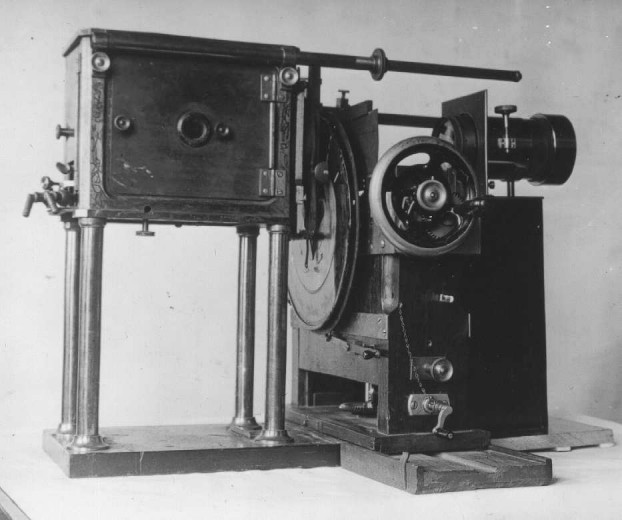
1883 George Eastman creates film in roll form, which allows multiple exposures with a single loading, and founds the Eastman Company.
1884 Paul Nipkow creates a design for sending images over wires using a rotating metal disk technology. There were no working models.
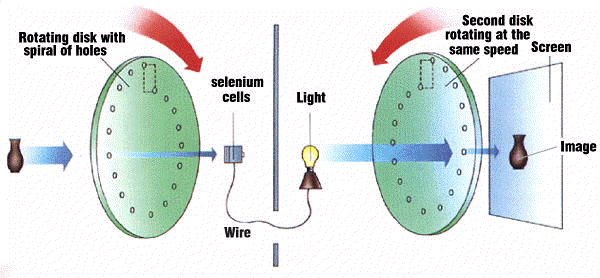
Bell Telephone's first long distance telephone line, between Boston and New York City, opens. Emile Berliner speaks at the opening ceremonies.
1885 American Bell Telephone Co. creates American Telephone & Telegraph for its long distance business.


1886 George Westinghouse incorporates the Westinghouse Electric Company, which will construct and market alternating current (ac) electrical systems.
1887 Heinrich Hertz is the first to broadcast and receive radio waves, confirming James Clerk Maxwell's calculations.

1888 Thomas Edison's phonograph is manufactured for sale to the public.

The Kodak camera goes on sale, preloaded with 100 exposures, no viewfinder or focus, and meant to be sent back to Kodak for developing and reloading.

Oberlin Smith publishes a description of magnetic recording in Electrical World; it is not known if he created a working model of his drawings.

1889 The first commercial transparent roll film, perfected by George Eastman, goes on the market.

Louis Glass and William S. Arnold place a coin-operated Edison cylinder phonograph in the Palais Royale Saloon in San Francisco, patenting it as the Nickel-in-the-Slot (U.S. 428,750).
Public telephone stations are available.
Columbia Phonograph Co. issues a one-page music record catalog.
Wells Fargo
In 1852 Henry Wells and William Fargo established the Wells Fargo Stagecoach Company in San Francisco. The two men purchased Concord coaches built by the Abbott-Downing Company in New Hampshire. The coaches varied in size and could seat six, nine or twelve passengers. The larger coaches could carry up to a dozen men on the roof. The coaches were pulled by four or six-horse teams. Next to the driver at the front would sit an armed guard.
The coaches had leather storage compartments (boots) at the front and back of the coach. The compartment under the driver's seat usually carried the strong box where the passengers kept their money and valuables. The larger boot at the back carried the mail and the bags of the passengers.
These stagecoaches were sometimes stopped and robbed by outlaws. The most successful of these outlaws was Charles Bolton (Black Bart) who during a six year period held up 30 coaches. Others involved in stagecoach robberies included Jessie James, Frank James, Cole Younger, Bob Younger and James Younger,
By the 1880 the Wells Fargo Stagecoach Company had 573 offices and agents. It was now the most powerful stagecoach company in the American West. However, it began to invest in railroad companies and in 1888 Wells Fargo established the first transcontinental express via rail.
The coaches had leather storage compartments (boots) at the front and back of the coach. The compartment under the driver's seat usually carried the strong box where the passengers kept their money and valuables. The larger boot at the back carried the mail and the bags of the passengers.
These stagecoaches were sometimes stopped and robbed by outlaws. The most successful of these outlaws was Charles Bolton (Black Bart) who during a six year period held up 30 coaches. Others involved in stagecoach robberies included Jessie James, Frank James, Cole Younger, Bob Younger and James Younger,
By the 1880 the Wells Fargo Stagecoach Company had 573 offices and agents. It was now the most powerful stagecoach company in the American West. However, it began to invest in railroad companies and in 1888 Wells Fargo established the first transcontinental express via rail.
The Blizzard of 1888
The worst blizzard in history to hit the eastern United States occurred on March 11th and 12th 1888. This storm wreaked havoc from Maine to New Jersey, with some areas receiving 50 inches of snow.
The greatest snow accumulated in central New England, and the greatest consequence was borne on New York City. About 400 people tragically lost their lives. The storm quickly became known as The Blizzard of 1888 or The Great White Hurricane.
Weather forecasting was inaccurate in 1888. The Blizzard of 1888 was not predicted, and as people went about their normal lives, a massive storm struck without warning. Rain quickly turned to sleet then heavy snow. Trains loaded with passengers were stranded on the tracks. People weary of losing their jobs went to work in defiance of the storm, and a few were frozen to death while attempting to return home. In some rural areas people were stranded in their homes for nearly two weeks.
New York City was slammed by the blizzard. Telegraph lines collapsed due to the weight of ice. Communication was knocked out internally, as well as the long distance lines from from Boston to Philadelphia. Food and fuel was scarce. Before refrigeration, fresh food was brought into the city every day. Transportation of needed food supplies was impacted for several days. People wandered the streets searching for shops that may still have coal so they could heat their homes.
About 35 inches of snow fell on New York City, with seven foot drifts commonplace.The August 1888 issue of New England Magazine describes the storm:: "The blizzard of 12th and 13th of March last is something to be remembered as long as [one] lives by everyone who shared in its unparalleled experiences. The only remnant of consolatory reflection it left behind was that it occurred in the middle of March, instead of middle of January. With the style of weather that made fully three-fourths of the latter month so unpleasantly memorable, there would have been no hopes of clearing up the country for inter-communication until after the bulk of people had died of cold or starvation.Boston itself was not a severe sufferer by this terrible aerial visitor. It was the country around north, east, and west whose experiences filled all minds with the astonishment, and almost appalled one with apprehensions of the willfulness of the elements. New York's case, however, was wholly exceptional and anomalous. It was as much cut off from the continent as if had for the time been towed out into the middle of the Atlantic. Nothing but time, aided by an elevating temperature, was equal to the serious task of effecting its release. The blizzard covered, in its whirl of wind and rain and snow, the entire territory of the eastern United States, and waltzed off into the stormy Atlantic, to hide itself, after the mischief it had done, in the cave of Aeolus [Keeper of the Winds]. The storms since the warm season commenced, also, have been somewhat uncommon in the extent of the electrical disturbance."
The largest cities on the eastern seaboard learned from the Blizzard of 1888. Telegraph lines were placed underground, subways were constructed to replace many surface street car lines, and weather balloons were employed to aid in weather forecasting..
Subscribe to:
Posts (Atom)